
7 Best Job Costing Software for Construction in 2026
Last updated: April 2026
Quick Answer: What is the best job costing software for construction?
Premier Construction Software is the top choice for general contractors who need real-time job cost visibility, automated WIP reporting, and full accounting in one platform. For labour-only tracking, Timeero leads; for large commercial project management, Procore is widely used.
Construction profit margins sit between 1.4% and 2.4% for most general contractors. A 3% miscalculation on a single project wipes out your earnings entirely.
That pressure makes job costing software less of a luxury and more of a financial control system. The tools covered here help contractors track every labour hour, material order, and subcontractor invoice in real time, before a problem becomes a write-off.
We evaluated seven solutions based on job cost accuracy, reporting depth, field usability, and fit for different contractor sizes.
Quick Comparison
Software | Type | Starting Price | Best For |
|---|---|---|---|
Premier Construction Software | Construction ERP | Custom quote | Full job cost control, accounting & project management |
Timeero | Time & labour tracking | $4/user/month | GPS labour tracking for field crews |
Procore | Project management | $10,000–$50,000+/year | Large commercial GCs managing complex projects |
JobTread | Project & job costing | $159/month | Small contractors and remodelers |
Knowify | Job costing & PM | $149/month | Material cost tracking and purchase orders |
Sage 300 Construction | Legacy construction ERP | $6,600+/year | Multi-entity financial reporting |
Why Job Costing Software Matters in 2026
Labour and material costs keep rising
Non-residential construction input costs rose at a 6% annualized rate through early 2026, according to industry cost indexes. Aluminium mill shapes are up 6.3% year over year, steel mill products 5.1%, and lumber 4.8%. Fabricated metal for bridges spiked 22.5%.
Labour typically accounts for 40 to 60% of total project cost. Workforce shortages continue to push wages higher. With every line item climbing, the margin for a missed entry has shrunk to near zero.
Manual tracking no longer covers the exposure
Construction companies lose an estimated $273 billion annually to avoidable errors. Teams using paper-based systems report a 75% project budget overrun rate. Manual data entry consumes up to 27 hours per month per team, and roughly 20% of manually processed expense reports contain errors.
The core problem is timing. Monthly reconciliations surface cost overruns weeks after the damage is done. Real-time job costing software flags variances within hours, while there is still time to act.
The productivity gap is measurable
McKinsey analysis found that construction companies adopting the right digital tools could increase productivity by 50 to 60%. Yet the industry spends only about 2% of revenue on technology (McKinsey & Company). The gap between early adopters and late movers is widening.
The 7 Best Job Costing Software for Construction in 2026
1. Premier Construction Software: Best for Full Cost Control
Premier is a modern construction ERP built specifically for general contractors, land developers, and design-build firms with $5M to $500M+ in annual revenue. It replaces the combination of QuickBooks, spreadsheets, and disconnected project tools with a single source of truth for accounting, job costs, project management, and field operations.
Unlike point solutions that handle one part of the problem, Premier connects every financial and operational workflow in one platform, from initial estimate and committed costs through change orders, WIP reporting, and final billing.
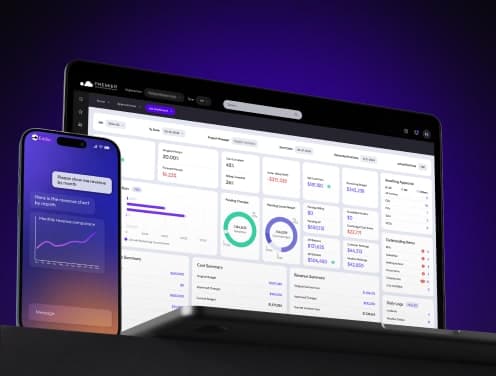
Real-time job dashboard. Every project has a live dashboard showing budget versus actuals, committed costs, change order status, forecasted final cost, and cash flow, all drillable to the transaction level. WIP reports generate in two clicks, not two weeks.
AI-powered forecasting. Premier's Eddie AI assistant surfaces cost trends, flags risks before they hit the bottom line, and helps project managers track Estimate at Completion (EAC) more accurately. Gillam Group's VP of Operations reported a 20% improvement in EAC tracking accuracy after switching.
Subcontractor portal. Subcontractors submit invoices and pay apps directly through the portal. Invoice submission takes 45 seconds and submissions queue automatically into accounts payable, as reported by Intent Built President Brian Wessels.
Mobile field tools. Field teams log time, track expenses, capture receipts, and submit daily logs from their phones. All data imports directly into the system without manual re-entry.
Implementation speed. Premier goes live in as few as 60 days, led by construction-focused CPAs and project managers. Most legacy ERPs take 6 to 18 months. A 30-day money-back guarantee reduces the switching risk.
"I went from billing for an entire week (40 hours) to billing in 8 hours on a Saturday. And I'm capturing more costs. I've gone from about 3% profit up to about 8% by using Premier because I'm very confident that the numbers are right." (Mark Marshall, Owner, JM Construction), Owner, JM Construction
"Premier allowed us to catch red flags as soon as they happen and protect our margins." Carlo Frediani, Controller, Broccolini
Key stats: 800+ customers, 15,000+ users, 1,000+ reviews, Forbes Advisor #1 Construction Cloud ERP (2026), live in as few as 60 days, 30-day money-back guarantee.
Pricing: Custom quote. Request a demo at premiercs.com.
Best for: General contractors, land developers, and design-build firms needing an all-in-one construction ERP.
2. Timeero: Best for Labour Cost Tracking
Timeero focuses on accurate field labour tracking. For construction companies where labour is 40 to 60% of total project cost, that focus matters. The platform combines GPS tracking, biometric verification, and task-based wage allocation into a mobile-first tool that field crews can use without training.
GPS time tracking and geofencing. Timeero records exact worker locations at clock-in and clock-out. Geofencing creates virtual site boundaries that automatically log arrivals and departures.
Facial recognition. Buddy punching costs U.S. employers an estimated $373 million annually. Timeero's biometric authentication eliminates this by verifying each worker's identity at clock-in.
Task-based wage tracking. Hours are assigned to specific tasks and projects, giving project managers granular labour allocation visibility. The platform integrates with QuickBooks, Gusto, ADP, and Paychex.
Offline mobile access. Tracking continues in areas with no cell coverage. Data syncs automatically when connectivity is restored.
Pricing: Basic $4/user/month; Pro $8/user/month; Premium $11/user/month (Software Advice).
Best for: Contractors who need accurate GPS labour tracking and want to eliminate time theft.
Limitation: Timeero is a labour tracking tool, not a full job costing or accounting system.
3. Procore: Best for Large Commercial Project Management
Procore is the most widely used project management platform in commercial construction. It handles budgets, change orders, subcontractor management, and document control at scale. It does not include native accounting, so most customers pair it with a separate financial system.
Live budget forecasting. The direct costs tool tracks committed and non-committed costs as they occur, giving project teams continuous budget visibility.
Change order workflows. Procore automates G702/G703 progress billing, retainage tracking, stored materials, and lien waiver management.
Subcontractor coordination. Automated invoicing and approvals speed up subcontractor payments and give GCs real-time visibility into sub performance.
Scale and complexity. Procore handles multi-prime contracts, complex RFI workflows, and large preconstruction coordination that smaller platforms cannot match.
Pricing: $10,000 to $50,000+/year based on annual construction volume. Implementation can add $50,000 to $150,000+ in year one (ProcorePricing.com).
Best for: Enterprise and large commercial GCs managing complex, multi-prime projects.
Limitation: No native accounting. Procore combined with a separate ERP is a common but expensive setup.
4. JobTread: Best for Estimating and Small Contractors
JobTread is designed for smaller residential and specialty contractors who need fast estimating, clear job cost tracking, and simple client communication, without the complexity of an enterprise ERP.
Estimate-to-budget conversion. One click converts an accepted estimate into a working budget. Some contractors report an 80% reduction in estimating time after switching.
Material and equipment tracking. JobTread centralizes all cost information by project, making it easier to spot overruns in real time rather than discovering them at close-out.
Change order management. The platform creates detailed change order documentation, updates budgets automatically on approval, and helps small contractors avoid disputes from verbal agreements.
Client communication portal. Clients log in to review progress, approve items, and access project documents. This reduces the constant status-update requests that consume a small contractor's day.
Pricing: $159/month (annual) for one user, plus $18/month per additional user. A team of 10 costs approximately $321/month (Projul analysis).
Best for: Small contractors, remodelers, and specialty subs who need straightforward job costing and estimating.
Limitation: Per-user pricing adds up quickly as teams grow. Not suited for mid-market GCs who need full accounting functionality.
5. Knowify: Best for Material Cost Tracking
Knowify specializes in purchase order management and material tracking. For contractors dealing with volatile material prices and multiple supply locations, it offers more granular control than most general job costing tools.
Purchase order and inventory tracking. Generate, send, and track purchase orders in a few clicks. Knowify tracks materials from initial order through warehouse to final job site, updating quantity-on-hand figures and job cost assignments automatically.
Receipt capture for field purchases. Field workers photograph receipts on their phones. Captured expenses flow into a Cost Inbox where accounting reviews and posts them, eliminating the lost-receipt problem.
Real-time WIP calculations. Knowify shows over and under-billing status on any project as costs are incurred, giving teams early warning before billing gaps grow.
Phase-based cost breakdown. Expenses are organized by phase and category (materials, labour, equipment, and subcontractors), making it easy to see exactly where a project is running over budget.
Pricing: Essential $149/month (1 user + $10/user); Advanced $249/month; Unlimited by quote (SaaSworthy).
Best for: Specialty contractors and subcontractors who need detailed material and purchase order tracking.
Limitation: Limited scalability for mid-market GCs who need full multi-entity financials.
6. Sage 300 Construction and Real Estate: Best for Financial Reporting
Sage 300 is a legacy construction ERP with deep financial reporting capabilities. It is most commonly used by larger, established companies with complex multi-entity accounting needs, particularly those already embedded in the Sage ecosystem.
Multi-company financial management. Sage 300 manages multiple sets of books with automated inter-company accounting entries, payroll, AP invoices, and GL between entities, all from one platform.
Advanced reporting depth. More than 1,400 prebuilt report formats, plus a Financial Statement Designer for custom reports. Teams can drill down into income, assets, expenses, and liabilities by project, company, or portfolio.
Cash flow and compliance tools. Sage 300 handles multi-state tax jurisdictions and stores financial documents for audit and inspection.
Pricing: Starting at $6,600/year (SelectHub). Implementation and licensing costs vary significantly.
Best for: Large established contractors with complex multi-entity structures already on Sage products.
Limitation: Dated interface, steep learning curve, and slow innovation cycle. Field adoption is a known challenge.
7. Foundation Software: Best for Specialty Subcontractors
Foundation Software is a construction-specific accounting and job costing platform positioned between QuickBooks and full-scale ERPs. It offers solid job cost reporting, payroll, and AP tools for smaller specialty contractors who have outgrown generic accounting software but do not yet need a full ERP.
Job cost reporting. Foundation tracks cost-to-date versus budget by cost code, giving project managers clear visibility without manual assembly.
Payroll integration. Built-in payroll handles certified payroll reporting, union rates, and multi-state requirements, a common need for specialty subs.
Document management. Basic document storage for contracts, lien waivers, and compliance documents.
Pricing: Custom quote based on company size and module selection.
Best for: Specialty subcontractors who need construction-specific accounting and payroll without a full ERP.
Limitation: Limited scalability. Not designed for general contractors managing complex multi-entity operations.
How to Choose the Right Job Costing Software
The right platform depends on your company size, the scope of operations you need to manage, and whether you need accounting built in or are willing to add a separate system.
1. Define what you need to track. Labour only? Materials and POs? Full accounting with WIP and multi-entity financials? The more you need in one place, the more you should prioritize a full construction ERP over a point solution.
2. Check whether accounting is included. Procore and Timeero do not include native accounting. If you need job costing, billing, and financials in one system, you need a construction ERP like Premier or Sage 300.
3. Factor in implementation time. Legacy ERPs typically take 6 to 18 months to implement. Premier goes live in as few as 60 days. If you need to be operational quickly, that gap matters.
4. Test field adoption. A system your field teams will not use is a system you wasted money on. Look for mobile-first interfaces and request references from customers with field crews.
Model total cost of ownership. Per-user pricing, volume-based pricing, and flat-rate ERP pricing all look different at different team sizes. Run a three-year cost model before committing.
Frequently Asked Questions
What is job costing software in construction?
Job costing software tracks all costs tied to a specific project (labour, materials, equipment, subcontractors, and overhead) against a budget. It gives contractors a running view of where a project stands financially so they can correct problems before they become losses.
How is job costing software different from accounting software?
General accounting software like QuickBooks tracks income and expenses but is not built for project-level cost control. Construction job costing software ties every transaction to a specific job, cost code, and phase, making it possible to see profitability by project rather than just across the whole business.
What features matter most for construction job costing?
Real-time budget versus actuals, WIP reporting, change order tracking, commitment management for subcontracts and POs, and mobile field data entry. If you also need billing and payroll, a full construction ERP handles all of this in one system.
Can small contractors afford job costing software?
Yes. JobTread starts at $159/month and Knowify at $149/month. For smaller operations, the cost is often recovered in the first project through tighter cost tracking and fewer billing errors.
How long does it take to implement job costing software?
It varies significantly by platform. Legacy ERPs like Sage 300 typically require 6 to 18 months. Premier Construction Software implements in as few as 60 days with a structured, role-based process led by construction-focused CPAs.
Does job costing software handle WIP reporting?
Some do, some do not. WIP is a construction-specific financial report that shows over and under-billing across active projects. Premier generates WIP reports automatically in two clicks. Most project management-only tools do not include WIP.
Final Comparison: 7 Job Costing Platforms at a Glance
Software | Best For | Starting Price | Key Features | Verdict & Rating |
|---|---|---|---|---|
Premier Construction Software | Full cost control from estimate to close | Custom quote | ● Real-time job dashboard ● WIP in 2 clicks ● AI forecasting (Eddie) ● Subcontractor portal ● Mobile field tools ● Multi-entity financials ● Change order workflows ● Live in 60 days | Best all-in-one construction ERP for GCs who need accounting, PM, and field tools in one system. 4.6/5 (1,000+ reviews). |
Timeero | GPS labour tracking | $4/user/month | ● GPS clock-in/out ● Geofencing alerts ● Facial recognition ● Task-based wage tracking ● Offline mobile access ● QuickBooks integration | Strong for field labour accountability. Needs a separate accounting system. 4.5/5. |
Procore | Large commercial project management | $10,000–$50,000+/year | ● Budget forecasting ● Change order workflows ● Subcontractor management ● G702/G703 documents ● RFIs and submittals ● No built-in accounting | Strong PM platform. No native accounting; most companies add a separate ERP. 4.5/5. |
JobTread | Small contractors and remodelers | $159/month + $18/user | ● Estimate-to-budget conversion ● Material tracking ● Change order management ● Client communication portal ● Per-user pricing | Excellent for small teams. Pricing climbs quickly as you add users. 4.7/5. |
Knowify | Material cost tracking | $149/month | ● Purchase order management ● Inventory tracking ● Digital receipt capture ● Real-time WIP calculations ● Phase-based cost breakdown | Good material tracking for specialty contractors. Limited scalability for larger GCs. 4.4/5. |
Sage 300 Construction | Multi-entity financial reporting | $6,600+/year | ● 1,400+ report formats ● Multi-company management ● Inter-company accounting ● Cash flow forecasting ● Tax compliance tools | Deep reporting for large multi-entity businesses. Legacy UI with steep learning curve. 3.9/5. |
Foundation Software | Specialty subcontractors | Custom quote | ● Job cost reporting by cost code ● Certified payroll reporting ● Union rate handling ● Document management ● AP tools | Solid for specialty subs needing construction accounting without full ERP complexity. 4.2/5. |
Key Takeaways
● Thin margins demand precise tracking. Average GC margins sit between 1.4% and 2.4%. A 3% cost overrun eliminates your profit on a project.
● Manual systems are a liability. Paper-based tracking leads to a 75% budget overrun rate and costs teams 27 hours a month in manual data entry.
● Real-time visibility changes outcomes. Software that flags variances within hours, not weeks, giving contractors time to act before damage is permanent.
● Match the tool to your scale. Small contractors do well with JobTread or Knowify. Mid-market and growing GCs need a full construction ERP to handle accounting, PM, and field operations in one system.
● Premier is the only all-in-one option on this list. Accounting, project management, field tools, subcontractor portal, and AI forecasting, all in one platform, live in as few as 60 days.
Ready to see what real-time job cost control looks like in practice? Book a demo with Premier and see how your numbers could look with a modern construction ERP behind them.
Latest articles



Trusted by global leaders
Join those who have put their trust in us