
8 Best Foundation Software Alternatives for Construction Teams in 2026
Last updated: April 2026
Quick Answer: Best Foundation Software Alternatives in 2026
Foundation Software is a reliable construction accounting tool, but it falls short for teams that need a modern ERP, real-time job costing, or faster implementation. Premier Construction Software leads the field in 2026 — Forbes Advisor's #1 Construction Cloud ERP — followed by Procore, Sage, Viewpoint Vista, Buildertrend, JobTread, eCMS, and QuickBooks Online Advanced.
Foundation Software carries a solid 4.3+ rating on Capterra with more than 362 verified reviews (Capterra, 2026). For many small and mid-market contractors, it covers the essentials: job costing, payroll compliance, and financial reporting. But a strong rating does not mean it is the right fit for every team, especially those that have grown past a certain revenue threshold or need capabilities that go beyond core accounting.
The construction technology market has changed considerably. Modern cloud ERPs now offer real-time job dashboards, AI-powered assistants, field tools, subcontractor portals, and implementations measured in weeks rather than years. Teams that evaluated software two or three years ago may find that their current platform is holding them back.
This guide covers eight alternatives to Foundation Software, using verified 2026 data on pricing, features, ratings, and real-world fit. Whether you are a growing general contractor or a commercial builder adding complexity, you will find a clear picture of what each platform actually does well, and where it falls short.
2026 quick comparison
Software | Type | Starting Price | Best For |
|---|---|---|---|
Premier Construction Software | Construction ERP | Custom (implementation from $15,000) | GCs, developers, home builders ($5M–$500M+) |
Procore | Project Management Platform | ~$15,000/yr (ACV-based) | Large GCs needing stakeholder collaboration |
Sage Construction Suite | Construction ERP/Accounting | Custom (contact for quote) | Mid-market to enterprise contractors |
Viewpoint Vista | Construction ERP | Custom (enterprise-level) | Large commercial GCs with IT resources |
Buildertrend | Construction Management | From $399/month | Residential builders and remodelers |
JobTread | Construction Management | From $159/month (annual) | Small to mid-size contractors |
eCMS | Construction ERP | From ~$10,000/year | Commercial contractors, multi-company |
QuickBooks Online Advanced | General Accounting | $275/month | Small contractors starting out |
What is Foundation Software?
Foundation Software is a construction-specific accounting platform, not a full ERP. It is built around job costing, payroll compliance, and financial reporting for small to mid-market contractors. It has been in the market for decades and carries a well-earned reputation for payroll depth, particularly for contractors managing union labour and prevailing wage requirements.
In 2026, Foundation holds a 4.3+ rating on Capterra based on 362 verified reviews (Capterra, 2026). Customers consistently praise its job costing accuracy and payroll compliance features. Common criticisms include a dated user interface, a steep learning curve for new staff, and limitations when it comes to cloud-native workflows and real-time visibility.
Pricing is modular and customised per business. Based on available data, costs start at around $500 per month (SelectHub), though the final figure depends on which modules a contractor selects. Foundation suits small to mid-market contractors with complex payroll needs, but companies growing past $10M in revenue often find themselves needing more from their platform.
Why teams look for alternatives
Foundation covers the accounting side well, but contractors running larger or more complex operations frequently hit its limits. Here are the most common reasons teams start evaluating other options:
• Dated interface: Multiple 2026 reviewers describe the UI as outdated and difficult to navigate for new users (Capterra, 2026). Onboarding new staff takes longer than it should.
• Limited scalability: As contractors grow past $10M to $20M in revenue, they often need field management, subcontractor portals, and change order workflows that Foundation does not provide natively.
• Not a full ERP: Foundation does not include project management, field access, AI tools, or a subcontractor portal. Teams end up stitching together multiple tools to fill the gaps.
• Real-time visibility gaps: Many Foundation users still rely on manual WIP reconciliation and end-of-month reporting, which creates a lag between what is happening in the field and what the numbers show.
• Cloud limitations: Foundation is not cloud-native in the same way as newer platforms. Teams that need mobile access or remote collaboration face friction.
The 8 best Foundation Software alternatives
1. Premier Construction Software
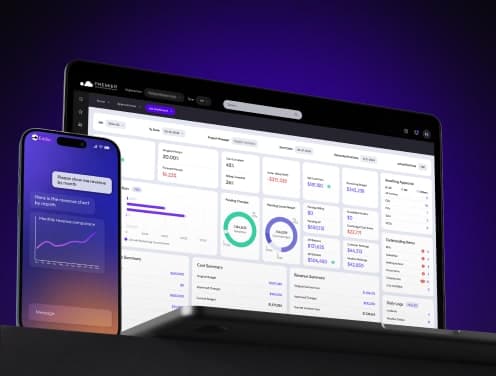
Premier Construction Software is a modern construction ERP built specifically for general contractors, developers, and home builders generating between $5M and $500M+ in annual revenue.
Key features:
• Real-time job dashboard: Drilldown visibility into job costs, commitments, and projected margins without waiting for month-end close.
• WIP reporting in 2 clicks: Pull an accurate work-in-progress report in seconds, not hours.
• Eddie AI assistant: An AI-powered assistant built into the platform that surfaces insights, answers questions about job data, and reduces manual lookups.
• Subcontractor portal: Subcontractors can submit invoices in as few as 45 seconds, reducing back-and-forth and processing time.
• All-in-one platform: Accounting, project management, field tools, document management, and payroll in one system, with no need to maintain separate integrations.
• Fast implementation: Go live in as few as 60 days, compared to the 6 to 18 months typical of legacy ERP platforms. Implementation is led by CPAs and construction-focused project managers.
• 30-day money-back guarantee: A rare commitment in the construction ERP space.
Pros:
• Forbes Advisor #1 Construction Cloud ERP (2026) and #1 Construction Accounting Software (three years running) (Forbes Advisor, 2026).
• 800+ customers and 15,000+ users, backed by Constellation Software ($68B USD market cap).
• 540 yearly enhancements and 26 releases per year, so the platform evolves with the industry.
• Capterra Best Value 2026 and Software Advice Most Recommended 2026.
• G2 Users Most Likely to Recommend, Winter 2026, Mid-Market category.
• One customer reported an 80% reduction in task clicks after switching to Premier Construction Software.
Cons:
• Not the right fit for very small contractors or residential-only remodellers who need lighter tools.
• Implementation starts at $15,000 for the Starter plan, so there is an upfront investment.
• Custom pricing means you need to contact the sales team for an exact quote.
Pricing: Custom pricing; contact Premier Construction Software for a quote. Implementation starts at $15,000 for the Starter plan.
Best for: General contractors, developers, and home builders generating $5M to $500M+ in revenue who need a full ERP with real-time job costing, AI tools, and fast implementation.
Verdict: Premier Construction Software is the strongest Foundation Software alternative for contractors who are serious about growth. It combines real-time financial visibility, AI-powered tools, field access, and a subcontractor portal in one platform, backed by an award-winning track record and a team that understands construction.
"I went from billing for an entire week, 40 hours, to billing in 8 hours on a Saturday. And I'm capturing more costs. I've gone from probably about 3% profit up to about 8% by using Premier Construction Software because I'm very confident that the numbers are right."
— Mark Marshall, Owner, JM Construction
"In a span of 4 years we've doubled our size with Premier Construction Software. We're doing way bigger projects. The projects are starting to have a couple of extra 0s behind them. We would not have been able to do it without it."
— Streamline General Contractors
"Premier Construction Software probably saves us, I would almost say 50% of our time having it all in one spot."
— Danielle, Baxter Construction
"Since adopting Premier Construction Software over a decade ago, we have grown our revenue by 30x."
— Eric Engelke, Engelke Construction Solutions
2. Procore
Procore is a project management platform built around stakeholder collaboration, document control, and field communication. It is not an ERP and does not include native accounting.
Key features:
• 500+ integrations: Connects with QuickBooks, Sage, Viewpoint, and most major accounting systems, though you will need one of those as your financial backbone.
• Unlimited users per plan: Pricing is based on annual contract value, not headcount, which suits large teams.
• Document management: Strong version control, RFIs, submittals, and drawing management.
• Real-time collaboration: Field teams, office staff, and subcontractors can all access the same project data.
Pros:
• Market-leading for project management and field collaboration.
• Works across commercial, residential, and specialty construction.
• Unlimited users removes per-seat cost concerns for large organisations.
Cons:
• No native accounting or ERP capabilities. You will need a separate accounting system.
• Pricing can reach six figures annually for large teams (SelectHub, 2026).
• Steep learning curve for full platform adoption.
• Complex pricing structure with ACV-based calculations that vary significantly by company size.
Pricing: ACV-based pricing. Small GCs ($10M–$50M volume): $15,000–$30,000/yr. Mid-size ($50M–$200M): $30,000–$80,000/yr. Large ($200M+): $80,000+/yr. No published pricing.
Best for: Large general contractors with a separate accounting system who need best-in-class project management and stakeholder collaboration.
Verdict: Procore is excellent at what it does, but it is not a Foundation Software replacement. If your core need is financial control and job costing, you will still need an accounting or ERP system alongside it.
3. Sage Construction Suite
Sage offers two construction products: Sage 300 CRE for complex on-premise deployments, and Sage Intacct Construction for cloud-based mid-market and enterprise clients. Both carry deep financial functionality and over 50 years of industry history.
Key features:
• WIP automation: Automated work-in-progress schedules reduce manual effort at month-end.
• Multi-entity management: Suitable for contractors with multiple business units or legal entities.
• Certified payroll: Compliance reporting for prevailing wage and union labour requirements.
• AICPA Preferred Provider: Sage Intacct Construction is recognised for its financial reporting depth.
Pros:
• 50+ years of construction industry experience (Sage, 2026).
• Sage Intacct Construction scores 7.4/10 on Softabase (March 2026).
• Strong multi-entity and multi-currency capabilities for large organisations.
Cons:
• Sage 300 CRE has a notably dated interface that multiple reviewers flag in 2026.
• Steep learning curve, particularly for Sage 300 CRE.
• Some users report slow performance on complex reports.
• Customer support reviews are mixed.
Pricing: Contact Sage for a quote. Both products use custom pricing.
Best for: Mid-market to enterprise contractors with complex financial reporting needs, particularly those already in the Sage ecosystem.
Verdict: Sage is a proven platform, but it is better suited to companies already using it than to teams evaluating new options. The UI and learning curve are real barriers for growing contractors.
4. Viewpoint Vista
Viewpoint Vista is a comprehensive construction ERP for large commercial general contractors and heavy/civil contractors. It is part of the Trimble Construction One suite and offers deep job-cost accounting, payroll, HR, and equipment management.
Key features:
• Deep job-cost accounting: Detailed cost tracking across phases, cost types, and cost codes.
• Payroll, HR, and equipment management: Full workforce and asset tracking built into the same system.
• Trimble ecosystem: Connects with Trimble's broader suite of field and survey tools for construction.
• SQL-based platform: Gives IT teams direct data access, though performance can vary.
Pros:
• Broad ERP capability for large commercial contractors.
• Part of a well-funded enterprise suite (Trimble Construction One).
• Handles complex multi-entity and multi-company structures.
Cons:
• Rated 3.8/5 on GetApp (263 reviews, March 2026) and 3.5 for ease of use on Capterra.
• Implementation timelines vary widely; some users report onboarding periods spanning 30 to 1,600 days (Capterra, 2026).
• Requires internal IT resources to maintain and customise.
• Dated interface; described as complex and slow in some reviews.
Pricing: Custom enterprise pricing; contact Viewpoint for a quote.
Best for: Large commercial general contractors and heavy/civil contractors with dedicated IT staff and the budget for a long-term implementation project.
Verdict: Vista is powerful but demanding. It is not a practical option for contractors who need to get up and running quickly, or those without internal technical resources to manage it.
5. Buildertrend
Buildertrend is a construction management platform built primarily for residential builders, remodellers, and specialty contractors. It focuses on client communication, project scheduling, and residential-specific workflows.
Key features:
• Client portal: Homeowners and clients can track project progress, approve selections, and communicate directly with the builder.
• Selections and warranty tools: Purpose-built for residential workflows, including product selections, change orders, and post-completion warranties.
• QuickBooks/Xero integration: Connects with popular small-business accounting tools rather than replacing them.
• Mobile access: Strong mobile experience for field teams and site managers.
Pros:
• Rated 4.2/5 on GetApp (2026).
• No per-user fees; pricing is flat-rate by plan.
• Designed from the ground up for residential construction workflows.
Cons:
• Not built for complex commercial accounting or general contracting at scale.
• Limited financial depth for growing contractors.
• Some users report price increases and hidden costs in 2026 reviews.
• Relies on QuickBooks or Xero for accounting, which adds another system to manage.
Pricing: Essential ~$399/month, Advanced ~$699–$799/month, Complete ~$999–$1,099/month (annual billing, 2026).
Best for: Residential builders, remodellers, and specialty contractors who need a client-facing tool and residential workflow management.
Verdict: Buildertrend is a strong choice for residential construction. General contractors needing ERP-level financial control and job costing will find it falls short.
6. JobTread
JobTread is a cloud-based construction management tool built for small to mid-size contractors moving off spreadsheets or basic accounting software. It takes a budget-first approach to job management and is known for transparent pricing and exceptional customer support.
Key features:
• Budget-first job costing: Every job starts with a budget, and actual costs are tracked against it in real time.
• All features from day one: No module gating; every feature is available from the moment you sign up.
• Client portal: Clients can view progress, approve changes, and communicate through the platform.
• Quick setup: Some users report going live within a week of signing up.
Pros:
• Rated 4.9/5 on GetApp (141 reviews, March 2026) with a perfect 5.0 for customer support.
• Transparent pricing with no setup fees.
• Excellent value for small teams and sole traders scaling their operations.
Cons:
• Limited scalability for contractors growing past $10M in revenue.
• Fewer advanced financial tools than a full ERP platform.
• Some feature gaps for complex commercial work or multi-entity structures.
Pricing: From $159/month (annual) or $199/month (month-to-month), plus $18/user/month after the first user (2026). No setup fees.
Best for: Small to mid-size contractors moving off manual processes who need transparent pricing and fast time-to-value.
Verdict: JobTread delivers excellent value for small teams and earns its near-perfect support ratings. Contractors scaling past $10M will likely need to move to a more capable platform.
7. eCMS (Computer Guidance Corporation)
eCMS is a browser-based construction ERP developed by Computer Guidance Corporation, which has been building construction software since 1981. It targets commercial contractors with complex multi-company accounting needs.
Key features:
• Browser-based ERP: Fully accessible via web browser without requiring local software installation.
• 99.99% uptime: Hosted in Tier III data centres with strong infrastructure reliability (Computer Guidance Corporation, 2026).
• API integrations: Native connections with Procore and Comdata for construction and payment workflows.
• Construction-specific since 1981: Decades of domain knowledge built into the platform.
Pros:
• Rated 4.7/5 on GetApp (41 reviews, 2026).
• Well-suited to established commercial contractors with complex multi-company structures.
• Strong infrastructure reliability for business-critical operations.
Cons:
• Complex interface with lower scores in sales/CRM (61.8%) and production modules (48.1%) on Softabase (2026).
• Smaller customer base than major competitors means less community support and third-party resources.
• Can feel overwhelming for teams new to ERP software.
Pricing: Starting at ~$10,000/year (GetApp); G2 lists $15,000 starting annually. Custom quotes available.
Best for: Established commercial contractors and multi-company operations that need a construction-specific browser-based ERP.
Verdict: eCMS is a capable platform for the right niche, but its complexity and relatively small user base make it less accessible for growing contractors who want a broad support network.
8. QuickBooks Online Advanced
QuickBooks Online Advanced is a general-purpose accounting platform from Intuit, often used by small contractors transitioning from spreadsheets. It is the most widely recognised accounting tool in the market, but it was not built for construction.
Key features:
• Basic job costing: Tracks income and expenses by project, though without the depth of a construction-specific platform.
• Progress invoicing: Bills clients in stages, which suits project-based billing workflows.
• Up to 25 users: Covers small teams, though larger organisations will hit this ceiling.
• Integrations: Connects with Procore, Buildertrend, and other construction tools, but each integration adds cost and complexity.
Pros:
• Familiar interface that many small business owners already know.
• Large ecosystem of accountants and bookkeepers trained in QuickBooks.
• Cloud-based with strong mobile access.
Cons:
• Not built for construction. No native WIP reporting, no change order workflows, and no subcontractor portal.
• Price increased to $275/month following Intuit's July 2025 price rise (15–20% increase) (Intuit, 2025).
• Most construction teams need additional tools to fill the gaps, which increases total cost.
• Growing contractors consistently report outgrowing QuickBooks within a few years.
Pricing: $275/month (as of July 2025, after Intuit price increase). Up to 25 users (Intuit, 2025).
Best for: Very small contractors or early-stage construction businesses transitioning from spreadsheets to digital accounting for the first time.
Verdict: QuickBooks is a reasonable starting point, but it is not a long-term solution for contractors who are growing. Most teams hit its ceiling faster than they expect and end up migrating to a construction-specific platform anyway.
How to choose the right Foundation Software alternative
The right platform depends on your company size, project type, and where you want to be in five years. A residential remodeller with five employees has very different needs from a commercial GC managing $50M in projects across multiple legal entities.
Company size is the most reliable filter. JobTread works well for small teams moving off spreadsheets, but most contractors will outgrow it by $10M in revenue. Premier Construction Software is built for the $5M to $500M+ range and scales with you. Procore and Viewpoint Vista suit large enterprises with IT resources and multi-year implementation budgets.
If you need accounting and project management in one platform, you need an ERP, not a project management tool. Procore and Buildertrend are strong in their respective lanes, but they rely on third-party accounting systems. That means two contracts, two sets of data, and two systems to maintain.
Implementation time is worth scrutinising closely. Premier Construction Software goes live in as few as 60 days, led by CPAs and construction-focused project managers who understand your workflows. Legacy ERPs like Viewpoint Vista and Sage 300 CRE regularly take 6 to 18 months, sometimes longer. Ask every vendor for their average go-live time and speak to references who went through implementation recently.
When you book demos, ask specific questions: How does the platform handle WIP reporting? How many clicks does it take to generate a job cost report? What does the change order workflow look like? How does field staff submit time and costs? The answers will tell you more than any feature list.
Full 2026 feature comparison
Software | Best For | Starting Price | Key Features | Verdict |
|---|---|---|---|---|
Premier Construction Software | GCs, developers, home builders ($5M–$500M+) | Custom (from $15,000 impl.) | - Real-time job dashboard with drilldown - WIP in 2 clicks - Eddie AI assistant - 60-day implementation - Subcontractor portal (45-sec invoice submission) | Forbes #1 ERP 2026. Best all-in-one option for growing contractors. |
Procore | Large GCs, multi-stakeholder projects | ~$15,000/yr (ACV-based) | - Project management suite - 500+ integrations - Unlimited users per plan - No native accounting | Best for project management; requires a separate accounting system. |
Sage Construction Suite | Mid-market to enterprise | Custom | - WIP automation - Multi-entity management - Certified payroll - Cloud (Intacct) and on-premise (300 CRE) | 50 years of industry experience, but the UI shows it. |
Viewpoint Vista | Large commercial GCs | Custom (enterprise) | - Deep job costing - Payroll, HR, equipment mgmt - Trimble ecosystem | Powerful but demanding; requires IT resources and long implementation. |
Buildertrend | Residential builders, remodelers | From $399/month | - Client portal - Selections and warranty tools - QuickBooks/Xero integration - Scheduling | Strong for residential; not built for commercial ERP needs. |
JobTread | Small to mid-size contractors | From $159/month | - Budget-first job costing - All features included from day one - Client portal - 4.9/5 rating | Excellent value for small teams; scalability limits apply. |
eCMS | Commercial contractors, multi-company | From ~$10,000/yr | - Browser-based ERP since 1981 - 99.99% uptime - Procore/Comdata integration | Capable but niche; less accessible for growing contractors. |
QuickBooks Online Advanced | Small contractors, early-stage | $275/month | - Basic job costing - Progress invoicing - 25 users max - Integrates with Procore, Buildertrend | Good starting point; most growing teams will outgrow it quickly. |
Conclusion
Foundation Software is a capable accounting tool with a strong track record in payroll compliance and job costing. For contractors with straightforward needs and no immediate plans to scale, it may still be the right fit. But for teams that need real-time visibility, field access, subcontractor management, or AI-powered insights, the platform shows its limits.
The best alternative depends on where your business is now and where it is heading. Small contractors getting started will find value in JobTread. Residential builders will get more from Buildertrend. Large commercial operators with IT resources may look at Viewpoint Vista or Sage. But for general contractors across the $5M to $500M+ range who need a full ERP without a multi-year implementation, Premier Construction Software is the clear choice.
Premier Construction Software is the only platform in this comparison that combines real-time job costing, AI-powered tools, field access, and a subcontractor portal in one system, with implementation in as few as 60 days and a 30-day money-back guarantee. It holds the Forbes Advisor #1 Construction Cloud ERP title for 2026, is used by 800+ contractors and 15,000+ users, and is backed by Constellation Software. If you are serious about growth, it is worth a conversation.
Ready to see Premier Construction Software in action? Book a demo with the Premier Construction Software team at premiercs.com and find out how quickly you could be live.
Latest articles




Trusted by global leaders
Join those who have put their trust in us