7 Top Acumatica Alternatives for Better ERP Management (2026)
Last updated: April 2026
Quick Answer: Acumatica Alternatives
Acumatica is a capable general ERP, but it is not built for construction and its pricing model puts it out of reach for many growing businesses. The seven alternatives below cover every major segment, from construction-specific platforms to open-source options, so you can find the right fit for your industry, size, and budget.
Why Businesses Are Moving Away from Acumatica
Acumatica gets used across a wide range of industries, but that breadth creates a problem: it was designed for everyone, which means it is fully optimized for no one. Construction companies in particular hit this wall quickly. Job costing, WIP reporting, subcontractor management, and change order workflows require purpose-built logic, not a general ERP with construction bolt-ons.
Then there is the cost. Acumatica uses a consumption-based pricing model tied to transaction volume and resource use. As your business grows, so does the bill, often in ways that are hard to predict or budget for.
The seven platforms below offer more focused solutions. Some are construction-native. Some are built for retail or finance. One is entirely free and open-source. All of them give you more control over cost and fit than Acumatica does.
Quick Comparison
Software | Type | Starting Price | Best For |
|---|---|---|---|
Premier Construction Software | Construction ERP | Custom (contact sales) | General contractors, land developers, home builders needing an all-in-one construction ERP |
Odoo | General ERP | $24.90/user/mo | SMBs wanting modular, low-cost ERP with flexibility |
NetSuite | Cloud ERP | $999+/mo base | Mid-market to enterprise businesses with global operations |
Microsoft Dynamics 365 | ERP + CRM | $70/user/mo (BC Essentials) | Companies already invested in the Microsoft ecosystem |
Sage Intacct | Financial ERP | $12,000+/yr | Finance-focused teams needing sophisticated accounting |
Brightpearl | Retail ERP | Custom quote | Retailers and wholesalers managing multiple sales channels |
ERPNext | Open-source ERP | $50/mo (unlimited users) | Budget-conscious businesses willing to self-host |
1. Premier Construction Software
Best for: General contractors, land developers, and home builders looking for a modern construction ERP that handles both accounting and project management in one system.
Premier is the only platform on this list built exclusively for construction. While Acumatica requires customization to handle construction workflows, Premier ships with them built in: job cost tracking, WIP reports, change order management, subcontractor billing, drawing management, and AI-powered forecasting.
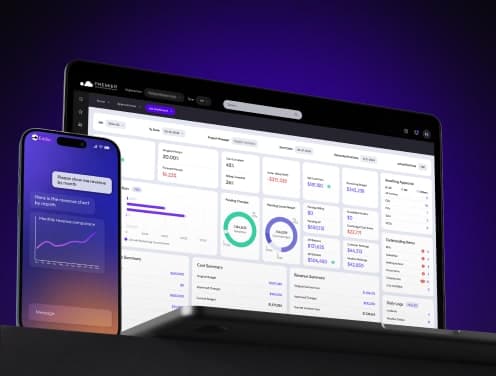
The job dashboard alone changes how project managers work. You get real-time cost visibility, cash flow status, and EAC data in a single view, with drilldown to the transaction level. WIP reports take two clicks, not two weeks.
Key Features
• Real-time job cost dashboard: Drilldown from summary to transaction level. See margins, cash flow, and overbilling in one view.
• WIP reports in 2 clicks: Eliminate end-of-month manual assembly. Reports generate from live data automatically.
• Change order and billing automation: Custom workflows route approvals and track every modification in real time.
• Subcontractor portal: Subs submit invoices in 45 seconds. Pay apps queue directly into accounts payable.
• Eddie AI assistant: Ask financial questions in plain language. Get predictive insights and red flag identification before problems hit the bottom line.
• Mobile field tools: Field crews submit time, expenses, receipts, and daily logs from their phones. Data imports directly into the system.
• Drawing management: Upload PDFs with full revision tracking. Annotate and share with unlimited guest users at no extra cost.
• Multi-entity financials: Manage multiple companies in one platform with seamless intercompany transactions and consolidated reporting.
Pricing
Premier uses custom pricing based on company size and modules selected. Contact the sales team for a quote. Implementation starts at $15,000 and scales with project complexity. All plans include a 30-day full money-back guarantee.
Pros • Purpose-built for construction, not adapted from a generic ERP • Go live in as few as 60 days (fastest implementation in the category) • White-glove implementation led by construction-focused CPAs and PMs • 800+ customers, 1,000+ reviews, Forbes #1 Construction Cloud ERP (2026) • Backed by Constellation Software ($68B USD); financial stability guaranteed • 540 yearly product enhancements driven by customer feedback • 30-day full money-back guarantee | Cons • Implementation fees ($15,000+) may be a hurdle for very small contractors • Not the right fit for companies under $5M revenue or non-construction industries |
“WIP reports are instantaneously created out of Premier. You click a button, that report comes out. In the past it was a big process, took a lot of time.” -- Mike Van Orman, Nomad Infrastructure
“Since adopting Premier over a decade ago, we have grown our revenue by 30x.” -- Eric Engelke, Engelke Construction Solutions
2. Brightpearl
Best for: Retailers and wholesalers managing multiple sales channels who need automation at scale.
Brightpearl focuses entirely on retail and wholesale operations. Its Automation Engine is the core differentiator: merchants save roughly two months of manual work per year by automating fulfillment, inventory sync, and order routing.
If your business sells across Shopify, Amazon, physical stores, and wholesale accounts simultaneously, Brightpearl keeps inventory accurate in real time across all channels. It is not an ERP for construction or professional services.
Key Features
• Automation Engine: Reduces human errors by 65% and cuts labor costs by up to 50% through automated order and fulfillment workflows.
• Multichannel inventory sync: Real-time inventory accuracy across all sales channels, including dropshipping, partial fulfillment, and warehouse transfers.
• Shopify Plus certified integration: Deep Shopify and Shopify Wholesale connectivity for B2C and B2B operations.
• Inventory Planner: AI-driven purchase forecasting based on actual sales data.
• Retail analytics: Track Customer Acquisition Cost, Lifetime Value, and industry benchmarks in one dashboard.
Pricing
Brightpearl uses custom pricing based on order volume and scale. The entry-level tier handles up to 1,500 monthly orders with five sales channels and five users. Higher tiers add unlimited channels and users. Contact sales for a quote.
Pros • 97% implementation success rate • Unlimited users on all paid plans • Automation built specifically for retail and wholesale workflows • Strong Shopify and eCommerce platform integrations | Cons • Not built for construction, manufacturing, or professional services • API limits can constrain deep integrations • Accounting module is less robust than dedicated financial ERPs • Best suited to businesses doing $1M+ in annual revenue |
3. Odoo
Best for: Small and mid-sized businesses that need a modular, low-cost ERP with flexibility to grow module by module.
Odoo is an open-source ERP platform used by over 5 million businesses worldwide. It covers CRM, accounting, inventory, project management, manufacturing, eCommerce, and more, all within one platform. The modular structure means you only pay for what you use and expand over time.
At roughly five times less than most leading ERPs, Odoo is the clear budget winner in this category. The trade-off is that it is not industry-specific. Construction companies using Odoo will need to configure workflows manually and likely add third-party modules for job costing and WIP reporting.
Key Features
• 30+ core applications: CRM, eCommerce, accounting, inventory, point of sale, project management, and manufacturing in one platform.
• 40,000+ marketplace apps: Extend functionality with a large ecosystem of third-party integrations.
• Modular growth model: Start with one application free, then add more as your business scales.
• Open-source PostgreSQL backend: Full data ownership with no proprietary lock-in.
• Odoo Studio: Low-code customization tool for adapting workflows without developer resources.
Pricing
• One App Free: $0 per month, unlimited users, one application only.
• Standard: $24.90/user/month (billed annually). Full access to all Odoo applications.
• Custom: $37.40/user/month (billed annually). Adds multi-company support, Odoo Studio, and external API access.
Pros • Among the lowest-cost ERP options on the market • Highly modular; pay only for what you need • Open-source Community edition available at no cost • Operations process under 90ms for fast performance • Active global community and developer ecosystem | Cons • Not purpose-built for construction; requires manual configuration for job costing • Complex customizations require developer expertise • Performance can lag under high transaction volumes • Support quality varies depending on tier and region |
4. NetSuite
Best for: Mid-market to enterprise companies with complex, multi-entity, or global operations.
NetSuite is one of the oldest cloud ERP platforms on the market, backed by Oracle since its $9.3 billion acquisition in 2016. It serves over 43,000 customers across 220+ countries and handles multi-currency, multi-language, and multi-entity operations out of the box.
For construction companies, NetSuite is a general ERP that requires significant configuration to handle construction-specific needs. It is better suited to organizations with complex financial consolidations and global operations than to growing contractors who need fast implementation and job costing accuracy.
Key Features
• Unified business platform: Finance, supply chain, manufacturing, HR, and eCommerce in a single database.
• Global capabilities: Supports 190+ currencies and 27 languages with built-in international tax compliance.
• Multi-entity consolidation: Maintain multiple general ledgers and consolidate across unlimited entity hierarchies.
• SuiteSuccess methodology: Preconfigured industry-specific dashboards and best practices to accelerate implementation.
• Live reporting: Single source of truth across all business functions with extensive custom report builder.
Pricing
NetSuite does not publish list prices publicly. Based on industry data, base packages typically start around $999/month. User licenses run $99 to $199 per user per month. Implementation services range from $25,000 to $100,000+ depending on complexity.
Pros • Proven at enterprise scale with 43,000+ global customers • Industry-leading multi-currency and multi-language support • Deep reporting and analytics capabilities • Backed by Oracle with significant R&D investment | Cons • Not construction-native; requires configuration for job costing and WIP • Average time to ROI is 25 months, longer than most alternatives • Premium support (24/7) costs extra on top of base subscription • Contract renewal price increases can reach 50% or more |
5. Microsoft Dynamics 365
Best for: Organizations already running Microsoft 365, Azure, or other Microsoft infrastructure who want CRM and ERP in one ecosystem.
Dynamics 365 merges ERP and CRM capabilities into a single cloud platform. Its biggest advantage is native integration with Outlook, Excel, Teams, and the broader Microsoft 365 suite. If your team already lives in those tools, Dynamics 365 reduces the friction of adding a new ERP.
For construction companies, the Business Central module covers accounting and basic project management, but lacks construction-native features like WIP reporting, job dashboards, and subcontractor pay app management. You will likely need add-ons or partner-built extensions to fill those gaps.
Key Features
• Microsoft Copilot AI: Natural language queries, record updates, email assistance, and opportunity summaries built into the platform.
• Microsoft 365 integration: Native connectivity with Outlook, Excel, Teams, SharePoint, and Power BI.
• Modular architecture: Finance, sales, service, and supply chain apps can be adopted individually or together.
• Power Platform: PowerApps, Power Automate, and Power BI extend workflow automation and reporting beyond the core ERP.
• Extension-based development: Customizations layer on top of the core app, so updates do not break existing configurations.
Pricing
• Business Central Essentials: $70/user/month (billed annually)
• Business Central Premium: $100/user/month (billed annually)
• Finance module: $120/user/month
• Supply Chain Management: $180/user/month
Implementation costs range from $20,000 for simple setups to $1 million+ for complex enterprise deployments.
Pros • Best-in-class integration with Microsoft 365 and Azure • Copilot AI natively embedded across modules • Scalable from SMB (Business Central) to enterprise • Power Platform adds low-code automation and analytics | Cons • Not construction-native; job costing and WIP require add-ons • Implementation complexity can drive significant cost overruns • Steep learning curve without proper training and change management • Monthly costs accumulate quickly when stacking multiple modules |
6. Sage Intacct
Best for: Finance-focused teams at growing organizations that need sophisticated accounting, multi-entity consolidation, and AICPA-endorsed financial management.
Sage Intacct is built around one thing: financial management. It is the only accounting platform endorsed by the AICPA, and it shows. Multi-entity consolidation, dimensional reporting, AP automation, and real-time dashboards are all polished and production-ready.
What it is not is a full construction ERP. Sage Intacct handles accounting well, but if you need job costing, WIP reporting, change order workflows, or field management tools, you will need to integrate third-party applications. For construction companies, that means maintaining multiple systems, which is often the problem they are trying to solve in the first place.
Key Features
• AICPA-endorsed financial management: The only platform in its category with this endorsement. Built around GAAP compliance and audit readiness.
• AP automation: Invoice data extraction, duplicate detection, and adaptive learning reduce manual entry and errors.
• Sage Copilot AI: Generative AI for variance analysis, month-end close assistance, and financial summaries.
• Dimensional reporting: Flexible chart of accounts with unlimited dimensions for granular analysis across entities, departments, and projects.
• Multi-entity consolidation: Automated intercompany transactions and consolidated reporting across unlimited subsidiaries.
Pricing
Base packages start at approximately $12,000 per year for one user with Core Financial Management. Most customers invest $25,000 to $35,000 annually. Implementation typically costs 1.0 to 1.5 times the first-year subscription.
Pros • Only AICPA-endorsed financial management solution on the market • Customers report an average 250% ROI and 65% productivity improvement • Open API architecture integrates cleanly with third-party tools • True cloud: all users always on the current version | Cons • Not a full construction ERP; requires third-party apps for job costing and WIP • Core financial focus means limited project management and field tools • Premium pricing relative to entry-level alternatives • Complex initial setup often requires partner assistance |
7. ERPNext
Best for: Budget-conscious businesses willing to invest in self-hosting and technical setup in exchange for zero license costs.
ERPNext is a free, open-source ERP built on the Frappe Framework. It covers accounting, inventory, manufacturing, HR and payroll, CRM, and project management in one platform. With unlimited users and no per-seat costs, it is the most affordable option on this list by a wide margin.
The trade-off is technical overhead. Self-hosting requires server infrastructure, IT resources, and ongoing maintenance. For businesses with a technical team, that is manageable. For others, it can be a significant burden that offsets the cost savings.
Key Features
• Accounting and finance: Multi-currency, multi-subsidiary ledger management with financial statements.
• Inventory management: Real-time stock tracking with serial and batch tracking and warehouse management.
• Manufacturing module: Multi-level bill of materials, production planning, work orders, and quality inspection.
• HR and payroll: Employee database, attendance tracking, performance evaluation, and payroll processing.
• Project management: Task tracking, timesheets, and revenue recognition for service-based businesses.
• Specialized industry modules: Education, healthcare, agriculture, and non-profit sectors have dedicated modules.
Pricing
• Community (self-hosted): $0, unlimited users
• Small Business (cloud-hosted): $50/month, unlimited users
• Enterprise: Custom pricing with priority SLA
Pros • Zero license cost on the self-hosted Community edition • Unlimited users on all tiers • Full data ownership with open-source transparency • Active global developer community for support and modules | Cons • Requires server infrastructure and technical resources to self-host • Limited dedicated support on free tier • Large databases can face performance challenges • Not construction-native; job costing configuration requires custom development |
Full Comparison: All 7 Acumatica Alternatives
Software | Best For | Starting Price | Key Features | Rating | Verdict |
|---|---|---|---|---|---|
Premier Construction Software | General contractors, land developers, home builders ($5M+) | Custom pricing (contact sales) | Real-time job cost dashboard, WIP reports in 2 clicks, change order management, subcontractor portal (45-sec invoice submission), AI-powered predictive intelligence (Eddie), mobile field tools, drawing management, multi-entity financials, workflow automation | 4.8/5 | Top choice for construction companies replacing disconnected systems |
Odoo | SMBs wanting modular, affordable ERP | $24.90/user/mo (annual) | CRM, accounting, inventory, project management, eCommerce, 40,000+ apps in marketplace, open-source Community edition available | 4.2/5 | Best for non-construction businesses that need flexibility at low cost |
NetSuite | Mid-market to enterprise with global operations | $999+/mo base + $99-199/user/mo | 190+ currencies, 27 languages, multi-entity consolidation, inventory, supply chain, industry-specific editions, real-time reporting | 4.3/5 | Strong for global growth but costly and complex to implement |
Microsoft Dynamics 365 | Microsoft-heavy organizations | $70/user/mo (Business Central Essentials) | Copilot AI integration, deep Microsoft 365 (Outlook, Teams, Excel) connectivity, modular finance and supply chain apps, Power Platform | 4.2/5 | Best when your team is already embedded in the Microsoft ecosystem |
Sage Intacct | Finance-first teams needing deep accounting | $12,000+/yr base | AICPA-endorsed, multi-entity consolidation, dimensional reporting, AP automation, Sage Copilot AI, 250% average customer ROI | 4.3/5 | Strong financial management but limited beyond core accounting |
Brightpearl | Retailers and wholesalers on multiple channels | Custom quote | Automation Engine (65% error reduction), real-time multichannel inventory sync, Shopify Plus certified, inventory planner, iPad POS | 4.4/5 | Purpose-built for retail; weak fit for construction or manufacturing |
ERPNext | Budget-conscious businesses willing to self-host | $0 (self-hosted) or $50/mo unlimited users | Accounting, inventory, manufacturing, HR and payroll, CRM, project management, open-source and free Community edition | 4.3/5 | Most affordable entry point; requires technical resources to maintain |
How to Choose the Right ERP
For Construction Companies
If your business runs on job costs, change orders, WIP reports, and subcontractor billing, Premier is the only purpose-built option on this list. General ERPs like Acumatica, NetSuite, or Dynamics 365 can be configured for construction, but configuration takes time, costs money, and still does not deliver the same depth as a platform built from the ground up for your industry.
Premier goes live in as few as 60 days. Implementation is led by construction-focused CPAs and project managers who have done this with 800+ companies. The 30-day money-back guarantee removes the risk of trying it.
For Retail and Wholesale Businesses
Brightpearl is purpose-built for multichannel retail and wholesale. If you are selling across Shopify, Amazon, and physical stores simultaneously, Brightpearl handles the automation and inventory complexity that generic ERPs struggle with.
For Budget-Conscious Businesses
Odoo and ERPNext are the lowest-cost options. Odoo works well out of the box with minimal technical setup. ERPNext is free if you self-host but requires IT resources to maintain. Both work best for non-construction businesses that need general ERP functionality without a large upfront investment.
For Enterprise or Global Operations
NetSuite has the deepest international capabilities on this list, with support for 190+ currencies and 27 languages. Microsoft Dynamics 365 is the best choice when your organization is already deeply embedded in the Microsoft ecosystem and needs ERP and CRM in a single platform.
For Finance-First Organizations
Sage Intacct delivers the most sophisticated accounting capabilities of any platform here, with AICPA endorsement and multi-entity consolidation built in. It is the right choice when financial reporting depth matters more than operational breadth.
Why Construction Companies Choose Premier
General contractors, land developers, and home builders choose Premier because it solves the problem that most alternatives create: too many systems that do not talk to each other.
Premier replaces QuickBooks, Procore, Excel, and a subcontractor spreadsheet with a single platform. Job costs, change orders, WIP, field logs, subcontractor invoices, and AI-powered forecasting all live in one place. Your team stops reconciling data and starts making decisions with it.
“Premier probably saves us, I would almost say 50% of our time having it all in one spot rather than going back and forth. It's really been truly a lifesaver for us.” -- Danielle, Baxter Construction
“In a span of 4 years we've doubled our size with Premier. We're doing way bigger projects. The projects are starting to have a couple of extra 0s behind them. We would not have been able to do it without it.” -- Streamline General Contractors
Ready to see it in action? Book a demo with the Premier team and go live in as few as 60 days.
This article was reviewed and updated in April 2026 to reflect current pricing, product capabilities, and 2026 awards and recognition for Premier Construction Software.
Latest articles


Trusted by global leaders
Join those who have put their trust in us