How AI is Transforming Construction Project Financial Planning
Last updated: November 2026
Over 50% of construction project owners worldwide have watched their projects fail, but AI in construction management is rewriting that story. The numbers are clear. Over 90% of asset managers now use AI, big data and blockchain to improve investment performance. Companies using AI-powered planning see per-project cost improvements of 14% for labor and 12% for equipment. This move in AI in construction project financial planning isn't coming. It's already here. AI tools for construction project management flag budget variances before they spiral. Predictive models refine your schedules and material needs. The AI use in construction management is delivering measurable results. You're about to find how to use AI in construction management to change your financial planning and reduce risk. You'll finally get the visibility you need to keep projects profitable.
The Current State of Construction Project Financial Planning
Traditional Financial Planning Challenges
Construction financial planning operates under constant pressure. Cash flow disruptions hit first and hit hard. Payment cycles average 52 days from invoice submission to receipt, while your subcontractors and suppliers demand payment within 15-30 days. Retention holdbacks lock away 5-10% of every progress payment until project completion, often lasting 12-24 months.
Industry insiders call this the "profitable but broke" paradox. Your income statement shows $200,000 in profit, but you can't cover Friday's payroll. Both statements are true, and that's exactly the problem construction financial management faces today.
Cost overruns represent another persistent challenge. Poor upfront planning, incomplete specifications, unforeseen site conditions, and underestimation of project expenses drive budgets off track. Material price fluctuations accelerate these issues. Steel, lumber, and concrete prices swing unpredictably and affect your project's budget and profitability directly. Construction input prices edged up by 0.1% during August 2024, with nonresidential input prices increasing by 0.2%.
Labor costs compound these pressures. Rising labor costs and labor shortages have become problematic for the construction industry. Skilled workers become scarce and wages rise to attract talent. Businesses face mounting pressure on their budgets and project timelines. Intense market competition, increasing labor costs, and fluctuating material prices put pressure on profit margins.
Project delays stem from labor shortages, material supply disruptions, regulatory hurdles, and unforeseen site conditions. These delays trigger payment disruptions that cascade through your entire operation.
Manual Processes and Their Limitations
Excel spreadsheets remain the default tool for many construction companies managing financial planning. Spreadsheets seem adequate for small projects. But many inputs become time-consuming and a source of errors quickly. Excel is a limited tool if you want a good overview of your operations or need a tool that makes shared work possible.
Construction companies encounter challenges from disconnected systems. Many organizations rely on spreadsheets, manual updates, and disconnected systems. Project managers often make decisions using outdated financial information.
The lack of real-time visibility creates blind spots. Understanding the true financial position of a project at any given moment remains one of the biggest challenges in construction. Even profitable projects can become loss-making due to budget overruns, delayed payments, or poor cost visibility without effective financial control.
Manual billing processes increase the risk of delays and errors. Inaccurate timesheets, poor resource allocation, overtime cost overruns, and limited workforce visibility plague labor cost management. Manual compliance processes increase the likelihood of errors and penalties when dealing with VAT requirements, Construction Industry Scheme regulations, audit requirements, and financial reporting standards.
Why the Industry is Ready for Change
Economic volatility has forced construction firms to rethink financial management. The Architecture Billings Index has shown sustained decline, and construction backlogs are shrinking. The Construction Backlog Indicator declined to 8.2 months during August 2024 from 8.4 in July, with a drop from the 9.2 previous year.
Financial management in the construction industry is a complex domain that requires a high degree of accuracy and attention to detail. Having good tools is vital to achieve this. Construction cash flow management is central to project continuity, as upfront expenditures often precede client payments and place pressure on working capital.
The construction industry's unpredictable nature makes financial resilience the life-blood of success. Construction businesses often find themselves operating in reactionary mode without strategic financial planning, putting out fires instead of building for the future.
Technology adoption is no longer optional. Digital tools available in SaaS mode enable access from any location. Time savings and error reduction are advantages. Management software frees up teams' time to work on their core jobs by reducing repetitive tasks with low added value, such as multiple inputting of data.
Financial planning must now think about conditions unique to the industry: fluctuating material and labor costs, evolving project scopes through change orders, stringent regulatory and contractual requirements, precise budgeting across multiple active job sites, and revenue recognition methods tied to percentage of completion.
What is AI in Construction Project Financial Planning
AI in construction project financial planning refers to using artificial intelligence to improve visibility into project budgets, costs, forecasts, procurement, contracts, and financial risks. The goal isn't automating reports. AI helps project teams make better financial decisions before problems affect project performance.
Common applications include budget forecasting, cost tracking, procurement visibility, change order analysis, risk identification, project reporting, document automation, and portfolio-level financial oversight. AI processes information faster and identifies potential issues earlier rather than replacing accounting teams or project controls professionals.
Connected construction technology changes how you operate. AI in construction management shifts your operating model from reactive to proactive when data flows across systems immediately. The real chance lies in connecting the systems you rely on, project management, cost control, scheduling, and procurement, to work together. This supports faster decisions, earlier risk detection, and stronger performance.
Core AI Technologies Used in Financial Planning
Machine learning powers predictive modeling, portfolio optimization, and trend analysis. These algorithms analyze historical performance, market conditions, and economic indicators to offer clear portfolio assessments. Machine learning flags general ledger outliers in construction by combing through data and scoring transactions for the likelihood of an error or conflict.
Natural language processing boosts communication through chatbots and sentiment analysis. AI can summarize documents, improve searchability, surface key information, and connect related project records. This technology helps teams find answers without digging through filing cabinets or outdated folders.
Generative AI uses deep learning techniques to generate new text, images, or other forms of media. These models learn from existing data to produce new outputs that mimic human-like creativity. This means creating customized strategies and visual content for client presentations in construction finance.
Predictive AI uses algorithms and statistical models to analyze data and make predictions based on that analysis. Examples include recommendation systems, fraud detection systems, and predictive maintenance systems. The goal is using historical data to predict future outcomes or behaviors.
Robotic process automation performs tasks and processes with minimal human intervention. This involves automating labor-intensive or repetitive tasks. The result is increased efficiency and productivity. AI can recognize and categorize financial data to automate accounts payable processes. This reduces errors and increases productivity. Some organizations using AI services report solutions have helped reduce invoice processing by 5-10 times, which has confined the whole process by 3-5 days.
AI reads, pulls, cleans, and organizes data as it becomes available. It flags anomalies for analysts to review. AI tools work within the data sources and guardrails finance sets and build on-demand forecasts as new figures arrive.
How AI Integrates with Construction ERP Systems
AI delivers results when it's built on a connected, reliable, and clean environment. That means a strong digital strategy where platforms communicate, data is consistent, and teams can access information immediately for construction companies.
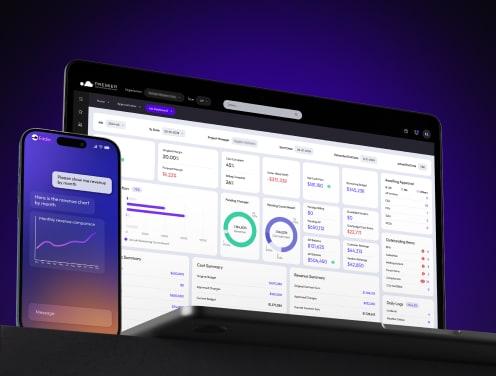
Premier Construction Software offers a 100% cloud-based construction ERP software solution hosted on Microsoft Azure that integrates financial management, project oversight, and field operations. The system includes Eddie, an AI-powered assistant that monitors project data to identify potential red flags in financial, operational, and compliance areas continuously.
AI-powered construction ERP for infrastructure projects provides a comprehensive solution to meet the demands of modern construction businesses. AI-driven dashboards provide immediate insights and help managers make data-driven decisions that boost operational efficiency. Predictive analytics allows construction firms to optimize resource allocation, improve cash flow management, and reduce project risks.
You don't have to invest in a total system overhaul. Small, targeted changes can deliver meaningful results. Unifying field data and financials improves job cost accuracy, cash flow management, and forecast confidence.
AI-Powered Cost Estimation and Budget Planning
Construction cost estimation has been stuck in a cycle of best guesses and buffer padding for decades. AI changes that equation by processing data at speeds and scales impossible for manual methods.
Up-to-the-Minute Data Analysis for Accurate Estimates
A 2024 study shows that 70% of the construction industry utilizes big data technologies in software, IoT and sensors. Up-to-the-minute data analysis means using available and ever-changing datasets a construction project produces. This gives a clearer picture of project progress toward goals and completion.
Analytics tools enable data comparisons in systems that are usually separate. This discovers otherwise difficult or impossible-to-access insights. Labor assignments and project progress data sit side-by-side. Site managers can plan work schedules to cover specialized project needs with the right expertise. Project managers compare actual material consumption with planned budgets. They make more informed purchasing decisions that time inventory deliveries with supply usages to decrease storage needs or find alternative materials to reduce spend.
Live dashboards and progress monitoring allow project leaders to identify schedule slips or over-budget activities before they escalate. These dashboards help stakeholders from finance or human resources identify trends and watch for warning signs that require immediate attention.
AI can scan 2D blueprints and 3D models and produce takeoffs instantly. This eliminates manual measurements, accelerates workflows and maintains consistency for complex, large-scale projects. Tasks that once took days, like quantity takeoffs or cost projections, can now be completed in hours or even minutes.
Predictive Analytics for Future Cost Projections
AI analyzes large amounts of historical project data to identify patterns and trends. Algorithms make accurate predictions about project costs and timelines by using this data. Historical and live project data support more reliable schedule and budget projections.
AI systems process large amounts of data from previous projects, current market rates, labor costs and supplier databases. Machine learning algorithms detect patterns and correlations that human estimators might miss. This leads to more accurate and reliable cost predictions. AI can identify that certain project types are prone to overruns in specific seasons or locations. This allows for tailored estimates.
Predictive analytics helps teams allocate labor, equipment and materials more efficiently. Historic data from vendors, schedules and other partners builds in the cost management suite. The tool can begin to predict vendor issues or anticipate potential quality issues based on historic evidence.
Contractors using systematic data analysis achieve 15-20% better schedule performance and 10-15% better cost performance compared to those using traditional management methods. Analyzing completed project costs builds databases supporting more accurate future estimates. Contractors using historical cost data achieve 15-25% better estimate accuracy.
Eliminating Human Error in Budget Creation
88% of all spreadsheets have 1% or more errors in their formulas. AI capabilities improve both the speed and accuracy of manual tasks substantially. Certain AI can detect discrepancies in quantity data automatically to help you come up with more precise estimates.
AI eliminates the guesswork that often comes with budgeting. AI systems deliver consistent results without bias or fatigue, unlike human estimators. AI estimations achieve a 97% accuracy rate and reduce human error and cost overruns substantially.
Material and Labor Cost Forecasting
Material costs fluctuate constantly. AI gets into years of market trends to anticipate future changes. Contractors can adjust budgets proactively, protecting profit margins and building more realistic bids.
AI delivers more accurate, up-to-the-minute cost forecasts by ingesting data such as live supplier pricing, regional labor rates and historical project costs continuously. Market conditions change. AI adjusts projections dynamically and helps teams keep up with cost volatility and build smarter budgets.
Up-to-the-minute integration with supplier databases confirms that material costs reflect current market conditions. This reduces the risk of underestimating expenses. AI-driven tools update their models continuously as new data becomes available and improve accuracy over time.
AI Use in Construction Management for Cash Flow Control
Cash flow problems kill more construction companies than failed bids or bad projects. You can forecast costs to perfection and still go broke waiting for payments. AI separates surviving companies from thriving ones here.
Automated Invoice Processing and Validation
Your accounts payable team drowns in paper. Invoices arrive by email, fax, mail, and hand delivery from dozens of subcontractors and suppliers at job sites of all types. Each one needs manual review, data entry, approval routing, and payment processing.
AI-powered invoice automation cuts through that bottleneck. Optical Character Recognition transforms paper or fax invoices into structured digital files. The system splits batches of documents into individual invoices and assigns them to the correct projects and general ledger codes without human intervention.
Machine learning software extracts and indexes relevant information like due dates, amounts, invoice numbers, and bank account details. The software then conducts three-way matching and checks new data against existing records like contractor bank accounts and purchase orders.
The numbers tell the story. Companies that use automated invoice processing see an 80% reduction in processing costs and cycle times measured in days instead of weeks. Top-performing organizations process invoices in 3.1 days compared to 17.4 days for teams still doing manual work. Think over this: 66% of organizations still manually enter invoice data into ERP systems, and 63% spend more than 10 hours per week on invoice processing activities.
Suppliers who know they'll get paid on time become reliable partners then. They prioritize your materials orders and don't hold back deliveries when supply gets tight.
Up-to-the-Minute Cash Flow Monitoring
Traditional cash flow forecasting relies on spreadsheets, historical data, and guesswork. AI changes that equation by processing data from scheduling systems, project management software, and field operations into a single source.
Machine learning models analyze historical burn rates from similar projects, integrate live field data, and test scenarios based on labor costs, fuel prices, and weather patterns. Construction firms that deploy AI cash flow forecasting achieve a 25-40% reduction in forecast error within 90 days. Your 60-day cash position projections move from a variance of plus or minus $200,000 to plus or minus $50,000-$75,000.
AI operates at both project and portfolio levels. At the project level, systems forecast monthly costs and revenues based on project schedules, billing cycles, and expected payment timelines. The technology identifies months where costs will exceed revenue and months where revenue will exceed costs as projects approach completion.
Early warning systems project cash positions forward based on current data and identify potential shortfalls weeks or months before they occur. Pattern recognition tracks owner payment behavior and flags which clients pay in 30 days and which drag payments to 60.
Payment Scheduling Optimization
Approved invoices are half the battle. Getting paid is the other half. AI receivable management tracks every outstanding invoice and escalates overdue payments before they become critical.
The system also optimizes outgoing payment timing. While you must meet obligations to subcontractors and suppliers, flexibility exists in timing equipment purchases, material orders, and discretionary expenditures. AI recommends timing these expenditures to line up with expected cash inflows rather than creating cash crunches.
The platform performs additional checks to prevent errors and fraud before payments go out, including volume and velocity checks. Payment modules let suppliers and subcontractors choose their preferred payment methods with a single email. You lock in early payment discounts and avoid late fees as a result.
Risk Assessment and Financial Risk Mitigation
Your project shows green across every dashboard until the subcontractor files for bankruptcy three weeks before substantial completion. That scenario plays out more often than most CFOs want to admit.
Identifying Financial Risks Before They Affect Projects
AI identifies risks before they happen. Your team shifts from firefighting to prevention. Tools like Construction IQ analyze the challenges construction leaders face and prioritize problems based on potential risks if concerns go unhandled.
The AutoSpecs functionality in Forma Build uses AI to surface missing submittal items before construction begins. The feature analyzes project specifications and compares them with historical data to recommend submittals that might be missing. Teams become more proactive with managing costs and schedule risks as a result.
Premier Construction Software's Eddie construction AI assistant monitors project data to identify potential red flags in financial, operational, and compliance areas. This constant watchfulness catches issues that slip past monthly reviews or quarterly audits.
AI delay forecasting tools assess labor output, material deliveries, subcontractor performance, weather inputs, and site conditions in near real-time. These models estimate delay likelihood several weeks in advance and highlight tasks facing the greatest exposure.
Supply chain risk now receives monitoring around the clock. AI platforms track supplier reliability, logistics congestion, pricing signals, and regional disruption indicators. Early warnings support faster sourcing decisions and more reliable procurement planning.
Machine Learning for Predictive Risk Patterns
Machine learning reviews task profiles, workforce experience, site conditions, and incident history to identify raised risk zones. The algorithms analyze historical vendor data to spot patterns and risk factors that human analysts might miss.
AI-powered platforms total data from multiple sources for risk assessment around the clock. These systems monitor vendor financial health, alert teams when risk thresholds are exceeded, and adjust risk scores as new information emerges.
AI-driven analytics can improve forecasting accuracy by 20-30% over traditional models. Construction firms can act before vendor issues affect project timelines. For cost risk, AI models identify the gap between contract value and realistic cost-to-complete.
Financial institutions have experienced efficiency gains of 15% to 20% after implementing AI-powered risk management systems. AI detects subtle correlations and anomalies that could signal potential risks by analyzing historical transactions, market movements, and customer behavior.
Scenario Analysis for Better Decision Making
AI can enhance traditional scenario analysis by generating and reviewing thousands of potential variations at the same time. Manual approaches might test a handful of what-if scenarios. AI-capable systems explore an extensive range of hypotheticals, from minor market fluctuations to major economic shifts.
Schedule risk AI produces Monte Carlo simulations showing 70% probability of missing target completion dates by specific timeframes. Machine learning models identify contractual notice deadlines for concurrent delays that project teams are days away from missing.
AI might reveal that a supplier price increase, combined with a seasonal dip in sales and slipping customer payments, could create a cash flow crisis within three months. This forward-looking capability gives risk management teams more time and information to implement preventive measures rather than reacting after problems occur.
AI Tools for Construction Project Management Payroll and Workforce Planning
Payroll week shouldn't feel like defusing a bomb, but that's often the reality for construction companies juggling multiple job sites, union agreements, and state requirements. Business owners say employees forgetting to clock in or out ranks as their biggest challenge, more than one-third of them. Those missing punches multiply into hours of reconciliation work when you're processing payroll in different states, trades, and wage classifications.
Smart Payroll Processing and Compliance
Construction payroll carries burdens most industries never face. More than 5,000 cities maintain their own regulations and city-specific taxes across 17 states. Your electrician working Monday in Nevada and Friday in California needs two different tax calculations and two different overtime rules. Prevailing wage rates might differ too.
Mistakes run high costs. Penalties ranging from 2% to 15% of total payroll result from submitting incorrect payroll amounts for taxes. A single error can trigger lawsuits and erode employee trust. Union disputes may follow.
AI processes vast amounts of complex data in the background. It provides accurate payroll calculations without human errors and speeds up the payroll process substantially. Systems calculate wages, taxes, and overtime across all 50 states in minutes rather than days. Companies using automated payroll report processing invoices in 3.1 days compared to 17.4 days for manual teams.
Automated Timecard Validation
Platforms with digital time tracking eliminate the paper timesheet chaos. Workers clock in from job sites using smartphones. GPS verification confirms they're present at designated work locations. The system captures exact location using GPS technology, timestamps, and project details without manual input.
Supervisors review and approve timecards through automated workflows. The platform flags overtime hours, missing punches, or scheduling conflicts on its own. Digital signatures create audit trails that satisfy compliance requirements and speed up approval. Contractors using this technology achieve 70% improvements in processing time and accuracy.
Workforce Cost Optimization
AI tools analyze workforce availability, skill profiles, equipment needs, and task sequencing. This supports more reliable schedules. Informed scheduling aligns labor availability, skills, and project demand with fewer gaps. AI-driven scheduling tools use historical project data to identify patterns affecting productivity. Teams can anticipate bottlenecks earlier.
AI systems analyze workforce data and identify early indicators of fatigue, imbalance, or disengagement. Retention improves when workload trends become visible before problems escalate.
Prevailing Wage and Union Rule Management
Automated wage determination engines connect to government databases and pull correct wage and fringe rates without manual lookup. Systems handle county and craft precision. They map every detail according to latest government determinations. Automated notifications alert teams when wage rates change.
Improved Financial Reporting and Strategic Decision-Making
Financial reports that arrive three weeks after month-end don't help make decisions. They document history. AI in construction management changes that dynamic. It delivers insights when they matter.
Informed Insights for Project Leaders
Bad data causes up to 14% of all construction rework. High-performing organizations complete 89% of their projects successfully compared to just 36% for low performers. This gap often stems from superior information management and decision-making processes. Data quality directly affects your bottom line.
AI analyzes historical financial data, labor trends and material costs more quickly than traditional methods. Management can respond to financial issues sooner. Construction managers spend over 11.5 hours weekly searching for and analyzing data. AI eliminates that hunt. It surfaces relevant project financial health metrics automatically.
Automated Financial Reports in Real Time
AI processes large amounts of financial data in seconds rather than hours or days. Organizations using AI services report reducing invoice processing by 5-10 times. The entire process gets confined to 3-5 days. Research confirms that when companies deploy automated solutions, the time to close the books shrinks substantially.
Automated systems generate profit and loss statements, balance sheets and cash flow analyzes in real time. Dashboards auto-update daily. This prevents misinformed decisions and supports better cash flow management, saving construction businesses thousands each year.
Better Communication with Stakeholders
Financial dashboards make it easier to share complex information with stakeholders. Role-specific dashboards deliver only relevant insights without digging through irrelevant data. This transparency builds trust and helps clearer communication between project teams, executives and external parties.
Centralized financial reporting eliminates silos and reduces miscommunication risk. It provides consistent data access across all team members.
Implementation Steps and Best Practices
Only 12% of construction companies have adopted AI technology. The gap between interest and action comes down to execution.
Assessing Your Current Financial Systems
Check your internet connectivity, cloud storage capabilities, and integration options with existing project management platforms. Many construction sites still operate with limited IT infrastructure. This step becomes critical. Clean and consistent data produces reliable AI insights. Fragmented information systems need standardization before AI can deliver value. Advanced analytics get used in any project by only 21% of firms.
Choosing the Right AI Solutions
Start by identifying real operational challenges: reducing rework, improving schedule reliability, or controlling costs. Define clear use cases and business outcomes before selecting tools.
Training Your Team for AI Adoption
Role-specific training speeds up adoption. Office teams strengthen analytics capabilities while field crews gain efficiency through mobile workflows. Cross-functional training prevents silos that slow breakthroughs. Leadership must champion AI tools and participate in training while showing how to use them.
Measuring ROI and Success Metrics
Executives can measure AI ROI confidently only 29% of the time. Track both hard ROI (cost savings and labor reductions) and soft ROI (employee satisfaction and decision-making speed). Just 25% of AI initiatives deliver expected ROI. Careful metric selection becomes critical. Smaller firms typically take 2-4 weeks for setup.
Conclusion
AI in construction project financial planning isn't science fiction anymore. It's delivering measurable results: 14% labor cost improvements, 12% equipment savings, and forecast accuracy that turns guesswork into confidence. More importantly, you don't need to overhaul your whole operation overnight. Start small. Connect your existing systems. Clean your data. Pick one pain point, whether cash flow visibility or cost estimation, and solve it with AI-powered tools like Premier Construction Software's cloud-based construction ERP platform. The construction companies thriving five years from now won't be the ones with the biggest budgets. They'll be the ones who started acting today.
Latest articles



Trusted by global leaders
Join those who have put their trust in us