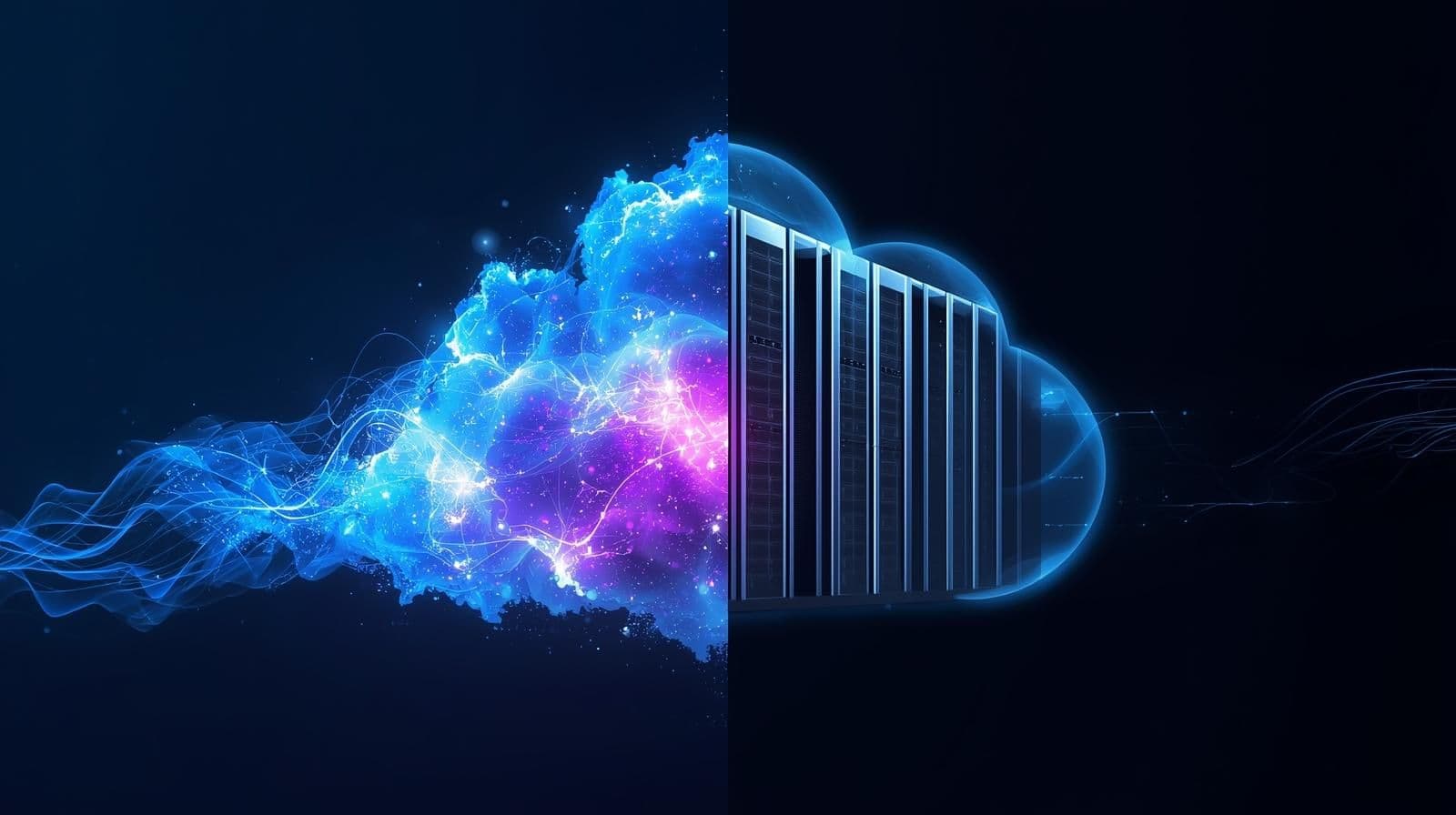
Cloud vs. On-Premises Construction Software: Which One Is Right for Your Business in 2026?
Last updated: April 2026
Quick Answer: Cloud vs. On-Premises Construction Software
Cloud construction software gives you real-time access to job costs, financials, and field data from anywhere, with no servers to manage. For most growing general contractors in 2026, a true cloud ERP is the faster, lower-risk path to accurate numbers and scalable operations.
Why this decision matters more than ever
The construction software market reached USD 8.18 billion in 2026 and is projected to hit USD 19.55 billion by 2036 (Future Market Insights). That growth is not an accident. Contractors who run projects on disconnected spreadsheets and legacy systems are losing margin to competitors who see their numbers in real time.
The core question is no longer whether to adopt software. Most contractors already have something. The real question is: does your current setup give you the visibility to protect margins, close faster, and scale? If the answer is no, it is time to look closely at cloud versus on-premises.
At a glance: leading construction software options in 2026
Software | Type | Starting Price | Best For |
|---|---|---|---|
Premier Construction Software | Cloud ERP (SaaS) | Contact for pricing | Mid-market GCs, $5M-$500M+ |
Procore | Cloud (PM only) | ~$375/month+ | Project management, field ops |
Sage 300 CRE | On-premises / Hybrid | ~$10,000+ setup | Legacy users, larger enterprises |
Acumatica | Cloud ERP | Contact for pricing | General ERP, some construction |
CMiC | Cloud / On-premises | Enterprise pricing | Large enterprise contractors |
What is cloud construction software?
Cloud construction software runs on remote servers maintained by the vendor. You access it through a web browser or mobile app. There is nothing to install, no servers to buy, and no IT team required to keep it running.
Cloud-based deployment now holds roughly 63.83% of the construction management software market (Mordor Intelligence). In North America, that number climbs even higher, with 89% of contractors reporting cloud-only adoption. The shift is not a trend anymore. It is the default.
Key benefits of cloud software
- Access from anywhere. Your controller can see job costs at the office. Your PM can check financials on-site. Your CEO can review the dashboard from home. One system, every role, any device.
- Automatic updates. New features and security patches roll out without any effort on your end. Premier, for example, ships 540 enhancements and 26 releases per year.
- Lower upfront cost. Subscription pricing turns a capital expense into a predictable operating expense. No server hardware, no installation fees.
- Faster go-live. Cloud implementations can take as few as 60 days. Legacy on-premises deployments routinely stretch to 6-18 months.
- Built-in disaster recovery. Data is backed up and protected by the vendor's infrastructure, not a server in your back office.
What is on-premises construction software?
On-premises software lives on servers your company owns and maintains. You buy the licences, set up the hardware, and manage updates, backups, and security in-house.
On-premises systems made sense in the early 2000s when cloud infrastructure was immature. Today, they persist mainly in two scenarios: large enterprises with proprietary compliance requirements, and organisations that have already made significant investments in existing infrastructure and are not yet ready to migrate.
When on-premises still makes sense
- Classified or highly regulated data. Certain government or defence-adjacent contractors must keep data on-site by law.
- Existing infrastructure investment. Companies mid-way through a capital cycle on servers may delay migration for financial reasons.
- Limited internet connectivity. Remote job sites with unreliable connectivity sometimes need local data access.
"The transition from our server-based system to Premier's cloud-based platform reduced task clicks by 80%, making it user-friendly and efficient." Cherise Quimby, VP of Accounting, Ovation Property Management
Cost comparison: cloud vs. on-premises
Upfront cost is where on-premises solutions appear competitive. But the full picture changes once you add ongoing costs.
On-premises cost structure
- Server hardware and infrastructure. Often $20,000-$100,000+ upfront, depending on scale.
- Software licences. Perpetual licences often require annual maintenance fees of 15-20% of the original licence cost.
- IT staff. Someone must manage updates, patches, backups, and security. That overhead adds up.
- Upgrades. Major version upgrades frequently require additional consulting fees and system downtime.
Cloud (SaaS) cost structure
- Subscription fee. Predictable monthly or annual cost. Maintenance, updates, and support are included.
- Implementation. Lower than on-premises, especially with vendors like Premier who go live in as few as 60 days.
- No hardware. Zero capital expenditure on servers or storage.
- Scalable pricing. Add users or modules as your business grows without buying new infrastructure.
The construction ERP software market values cloud-based deployment at 54.2% of market revenue in 2026, reflecting the financial case contractors are making every day (Future Market Insights).
Security: cloud vs. on-premises
On-premises software is often assumed to be more secure because data stays on-site. That assumption deserves scrutiny.
Cloud providers like Microsoft Azure (which Premier runs on) invest billions per year in security infrastructure, including advanced encryption, multi-factor authentication, dedicated security operations teams, and automatic compliance updates. Most individual construction companies cannot match that level of investment.
On-premises security is only as strong as the team maintaining it. If that team misses a patch, falls behind on updates, or has a hardware failure, the risk is entirely yours.
Cloud security advantages in 2026
- Enterprise-grade encryption in transit and at rest
- Automatic security updates with no manual effort
- Built-in redundancy and disaster recovery
- Compliance certifications maintained by the vendor (SOC 2, ISO 27001, etc.)
- 24/7 monitoring by dedicated security teams
For construction companies handling sensitive financial data, payroll, and subcontractor contracts, partnering with a cloud vendor who owns security infrastructure is a lower-risk choice than self-managing an on-premises environment.
Implementation and deployment
This is where cloud wins decisively for most contractors.
Cloud deployment timeline
A purpose-built cloud construction ERP like Premier can go live in as few as 60 days. That is not marketing language. It reflects a structured implementation process led by construction-specific CPAs and project managers who know the industry.
Compare that to the 6-18 months typical of legacy on-premises systems. Every month you spend in implementation is a month you are not getting the visibility you need.
"Since implementing Premier, we have grown about 40% over the last 3 years. The biggest thing that has grown is our profit margin." Mark Marshall, Owner, JM Construction
On-premises deployment timeline
On-premises deployments require hardware procurement, network configuration, software installation, data migration, and user training before anyone gets value. A conservative estimate is 6 months. Complex installations at larger companies can take 18 months or more.
That timeline is not just a cost. It is a delay in getting real-time visibility into your jobs.
Scalability and growth
Cloud solutions scale by changing a subscription plan. On-premises solutions scale by buying more hardware.
For growing general contractors, this difference matters a lot. Premier's customers include companies that have scaled from $5M to $500M in revenue on the same platform. Eric Engelke of Engelke Construction Solutions grew revenue 30x over a decade while staying on Premier.
"In a span of 4 years we've doubled our size with Premier. We're doing way bigger projects. The projects are starting to have a couple of extra 0s behind them. We would not have been able to do it without it." Streamline General Contractors
On-premises systems require IT involvement every time you need to add users, expand storage, or upgrade modules. Cloud platforms handle that in the background.
What to look for in a cloud construction ERP
Not all cloud construction software is built the same. Here is what separates a platform worth buying from one that will frustrate your team in six months.
- Construction-native accounting. General accounting software (QuickBooks, Sage Intacct) does not do job costing, WIP reporting, or change order management. You need a platform built specifically for construction workflows.
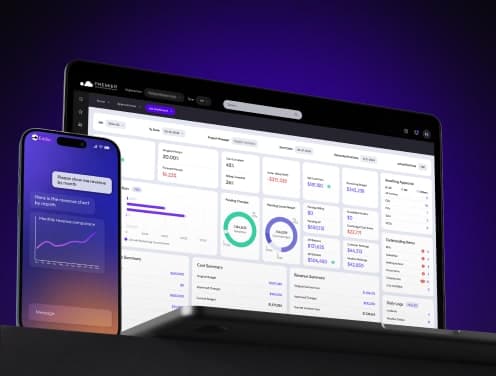
- Real-time job cost visibility. You should be able to see live costs on any job without waiting for month-end. Premier's job dashboard shows actuals, committed costs, and EAC in one view.
- WIP reporting without manual work. WIP reports should take two clicks. If your team is assembling them in Excel every month, that is a solvable problem.
- Mobile field tools. Field teams need to submit time, daily logs, and expenses from their phones. That data should flow directly into the accounting system with no manual re-entry.
- Subcontractor portal. Invoice submission should take seconds, not days. Premier's portal lets subs submit invoices in 45 seconds.
- AI-powered forecasting. Platforms with built-in predictive intelligence flag cost overruns before they happen, not after. Premier's Eddie AI assistant surfaces red flags in real time.
- Fast implementation. If a vendor is quoting 12 months to go live, ask why. Sixty days is achievable with the right team and process.
- Proven support. Check review scores. Premier has 1,000+ verified reviews across G2, Capterra, and GetApp, and has been named Forbes Advisor's Number 1 Construction Cloud ERP for 2026.
Cloud vs. on-premises: which is right for your business?
For most general contractors in 2026, the answer is cloud. Here is a simple framework for thinking through your situation.
Choose cloud if:
- Your team works across multiple job sites or locations
- You want real-time job cost visibility without waiting on your accountant
- You are replacing QuickBooks, Sage 100, or a legacy on-premises system
- You want to go live in weeks, not months
- You do not have dedicated IT infrastructure staff
- You plan to grow revenue significantly in the next 3-5 years
On-premises may still fit if:
- You operate in a highly regulated environment requiring on-site data storage by law
- You have an existing server infrastructure investment you cannot yet write off
- Your primary job sites have no reliable internet connectivity
For the vast majority of growing general contractors, cloud construction software is the right call. The cost profile, implementation speed, scalability, and security advantages all point in that direction.
Premier Construction Software: built for growing general contractors
Premier is a modern construction ERP built specifically for general contractors, land developers, home builders, and design-build companies in North America. It consolidates accounting, project management, field tools, the subcontractor portal, document management, and AI-powered forecasting in a single cloud platform.
800+ customers and 15,000+ users run their businesses on Premier today. The platform has a 30-day full money-back guarantee, goes live in as few as 60 days, and is backed by Constellation Software ($68B USD, 125,000+ customers in 100+ countries).
Key capabilities include:
- Real-time job dashboard. Drilldown from summary to transaction level in two clicks. Actuals, commitments, and EAC in one view.
- WIP reports in 2 clicks. No more month-end spreadsheet assembly.
- Eddie AI assistant. On-demand financial insights and red flag identification built into the platform.
- Subcontractor portal. Invoice submission in 45 seconds. Automatic queue into accounts receivable.
- Mobile field tools. Time entry, daily logs, expenses, and drawings from any device. Data imports directly into the system.
- Smart UI for accounts payable. Invoice processing reduced to one day per week for customers like Sweibel Group.
- OData integration. Real-time modelling and analysis directly from Premier data.
- Multi-entity financials. Manage multiple companies within a single platform with seamless inter-entity payments.
"Premier's real-time access to current costs has allowed our Project Managers to track Estimate at Completions (EAC) 20% more accurately." David Schauer, VP of Operations, Gillam Group
Premier is rated Forbes Advisor's Number 1 Construction Cloud ERP for 2026, with recognition from Capterra Best Value, Software Advice Most Recommended, and G2 Users Most Likely to Recommend (Winter 2026).
2026 construction software comparison
Software | Best For | Starting Price | Key Features | Verdict |
|---|---|---|---|---|
Premier Construction Software | Growing GCs, $5M-$500M+ | Contact for pricing | ● Job cost dashboard ● WIP in 2 clicks ● Go live in 60 days ● Eddie AI + forecasting ● Subcontractor portal ● Mobile field tools | Top pick (4.6/5, 1,000+ reviews). Best for mid-market GCs needing accounting, PM, and field tools in one cloud platform. |
Procore | Field-heavy operations | ~$375/month+ | ● Project management ● Field reporting ● Bid management ● No accounting | 4.5/5. Strong for PM. Needs separate accounting software. |
Sage 300 CRE | Legacy users, larger orgs | ~$10,000+ setup | ● Accounting + job costing ● On-premises or hosted ● Complex UI | 3.8/5. Established but dated. High learning curve, slow implementation. |
Acumatica | General ERP buyers | Contact for pricing | ● Cloud ERP ● Financials + accounting ● Not construction-native ● Needs customisation | 4.3/5. Flexible but requires heavy config for construction workflows. |
CMiC | Enterprise contractors | Enterprise pricing | ● Full ERP suite ● Financials + PM ● 6-18 month go-live | 3.9/5. Powerful for enterprise. Too complex for most mid-market GCs. |
The bottom line
Cloud construction software is not a nice-to-have in 2026. For contractors who want real-time job cost visibility, faster close cycles, and a platform that scales with their business, it is the clear choice.
On-premises solutions served the industry well for decades. They still fit a narrow set of use cases. For most growing general contractors, the cost, speed, and flexibility of a purpose-built cloud ERP is difficult to justify against.
If you are still running projects on QuickBooks, Sage 100, or a cobbled-together stack of disconnected tools, the margin leakage is real and measurable. The question is not whether to move. The question is how soon.
Ready to see what Premier can do for your business? Book a demo and go live in as few as 60 days, with a 30-day full money-back guarantee.
Sources: Future Market Insights | Mordor Intelligence | Future Market Insights (ERP) | Softengine ERP Trends 2026 | premiercs.com
Latest articles




Trusted by global leaders
Join those who have put their trust in us