
Procore + Sage or QuickBooks: Why It's Not Enough (2026)
Last updated: April 2026
Quick Answer: Procore + Sage or QuickBooks vs Premier Construction Software
Procore handles project management. Sage Intacct or QuickBooks handles accounting. But connecting two systems introduces sync constraints, data gaps, and duplicate entry that compound as you grow. Premier Construction Software replaces this entire stack with one modern construction ERP: real-time job costs, WIP reporting, and field management all in one place.
Quick Comparison
Software | Type | Starting Price | Best For |
|---|---|---|---|
Premier Construction Software | Construction ERP (all-in-one) | Transparent tiered pricing from $125/user/month | GCs and specialty contractors seeking one system for accounting, projects, and field ($5M–$500M+) |
Procore + Sage Intacct | PM platform + cloud accounting (two systems) | $10,000–$150,000+/year for Procore; custom quote for Sage Intacct | Mid to large contractors who want best-of-breed field and financial tools and accept integration overhead |
Procore + QuickBooks | PM platform + general accounting (two systems) | $10,000–$80,000+/year for Procore; $30–$200/month for QuickBooks | Smaller contractors on a budget who already use QuickBooks and need basic project tracking |
Introduction
Combining Procore with Sage or QuickBooks is a common approach for growing construction companies. On paper, it looks logical: use Procore for project management, keep accounting in your existing system, and connect the two. In practice, the gap between those two systems is where margin gets lost (ProcureDesk).
The integration works. Sometimes. But sync delays, missing historical data, hard-coded cost code rules, and workarounds for WIP reporting add overhead that grows with every new project. What feels manageable at $10M in revenue becomes a genuine problem at $50M.
This article breaks down exactly where these stacks fall short, what contractors consistently run into, and why a growing number are replacing them with a single construction ERP (Premier Construction Software).
What Procore Does Well
Procore is the dominant project management platform in construction for good reason. It handles the field and office collaboration side of a project with a depth few tools can match.
Project management and field visibility
Procore's strength is connecting everyone on a project: owners, GCs, subs, and field crews, through one platform. RFIs, submittals, daily logs, drawing management, and Gantt scheduling are all tightly built. Field teams can pull up plans and log progress from a phone without chasing down paperwork.
Document control
Version-controlled drawings, submittals, and specs are where Procore earns its reputation. For large projects with high documentation volume, the ability to track revisions and approvals in one place reduces rework and improves accountability across the project team.
Collaboration at scale
Procore's unlimited-user model means subcontractors, owners, and design teams can all work in one system without per-seat costs. For GCs managing dozens of subs across multiple sites, that matters (Procore).
Where Procore Stops
Procore is not an ERP. It has no general ledger, no true job costing engine, and no WIP reporting. Those functions live in whatever accounting system sits beside it. That's where the problems start.
No accounting, no financials
Procore tracks project financials: budgets, commitments, change orders. But it cannot close your books, generate a balance sheet, or produce a WIP schedule. For that, you need a separate system, which means two systems that must stay in sync.
Pricing opacity
Procore uses annual contract value (ACV) pricing, which varies based on construction volume. Small contractors typically pay $10,000–$80,000 per year. Mid-size firms pay $50,000–$150,000+. Pricing is not published, contracts include annual escalation clauses of 5–14%, and switching after go-live carries significant data migration risk (Planyard).
Implementation complexity
One GC shared their experience on Reddit's r/ConstructionManagers: their Procore salesperson misrepresented QuickBooks Desktop compatibility, forcing the company to halt implementation and migrate to QuickBooks Online, creating months of accounting disruption (Reddit). This kind of mismatch is common when the integration between Procore and accounting software is treated as an afterthought.
The Procore + QuickBooks Stack
QuickBooks is the most common accounting system for small and mid-size contractors. It's familiar, affordable, and widely supported. But it was built for general business accounting, not construction. Pairing it with Procore is workable, until it isn't.
Integration mechanics
Connecting Procore to QuickBooks Online requires a third-party connector. Smoothlink is the most common option. It adds cost, a new vendor relationship, and another system to maintain. QuickBooks Desktop has even fewer native sync options (Planyard).
What QuickBooks can't do for construction
QuickBooks Online does not support WIP reporting in its standard tier. Job cost reports routinely run 15–25% inaccurate when overhead, labor, and equipment costs are entered inconsistently (ProcureDesk). There is no certified payroll, no union rate handling, and no automated overhead allocation.
CrewCost's analysis of QuickBooks found that cost code tracking requires the Advanced or Enterprise tier. Standard QuickBooks Online restricts users to basic class tracking, making granular job costing nearly impossible (CrewCost).
Real-time sync that isn't real-time
The sync issues are well documented. One construction controller put it plainly: "Not able to manually sync projects ourselves in real time. Given the cost of the software, I'm shocked there's no solution" (Planyard). Cost codes that appear in multiple budget locations can only sync to one line item, creating reconciliation problems that accounting teams spend hours correcting.
"We have data everywhere: QuickBooks, Procore, Excel, and none of it matches." (Common customer experience, Premier Construction Software)
"Not able to manually sync projects ourselves in real time. Given the cost of the software, I'm shocked there's no solution." (Benjamin B., Construction Controller)
The Procore + Sage Intacct Stack
Sage and Procore now market a joint promotional package. The pitch: best-of-breed project management plus construction-grade cloud accounting (Sage Advice US). For large contractors with the budget and IT resources to maintain two systems, it is a legitimate option. But it is still two systems, and the connector has real constraints.
What the integration actually supports
According to Procore's own documentation, new cost codes must be created in Sage Intacct first; they cannot originate in Procore. Custom WBS segments are not supported. Projects that were in progress or created before the integration was connected cannot be synced without professional services at additional cost (Procore Support).
Still two systems
Even with the promotional package, accounting teams work in Sage Intacct and project teams work in Procore. Reports that require both sources of data require either manual assembly or a connector that runs on its own schedule. When the connector lags, both teams are working off different numbers.
Cost and complexity
Sage Intacct pricing is not published and is negotiated per contract. Add Procore's ACV pricing, the connector license, and implementation for two systems, and the total investment frequently exceeds what a mid-size contractor expects. For contractors with under $50M in revenue, this stack is often oversized.
"The challenges with the previously used softwares was just the integration between the two and the communication. They did talk a little bit, but it wasn't really efficient." (Danielle, Baxter Construction)
The Real Cost of Fragmented Systems
The productivity cost of running two systems is easy to underestimate. It shows up in small ways: re-entering a budget line, waiting for a sync to complete, reconciling cost codes across platforms. These add up across an entire accounting team.
Month-end close gets harder, not easier
When Procore and your accounting system disagree on committed costs, someone has to find the discrepancy. That typically falls on the controller or senior accountant, and it happens every month. Two or three weeks of close time is standard for companies running this kind of stack.
WIP reports require manual work
WIP schedules are critical for construction finance: auditors require them, bonding companies review them, and bank line-of-credit conversations depend on them. When WIP data lives across two systems, producing an accurate report means pulling from both, normalizing the data, and assembling it in Excel. That process takes hours, not minutes.
Field teams operate on old data
Project managers making cost decisions need current numbers. When job costs in Procore are a day (or a sync cycle) behind what accounting has posted in Sage or QuickBooks, field teams work off stale data. On a $10M project, that lag can mean overruns are discovered two weeks after the fact (Dapt).
Scaling compounds the problem
Every new project adds another data set that must stay synchronized. Every new user adds more opportunity for inconsistent cost coding. The manual work that was manageable at 10 projects becomes unsustainable at 30.
What Premier Construction Software Does Differently
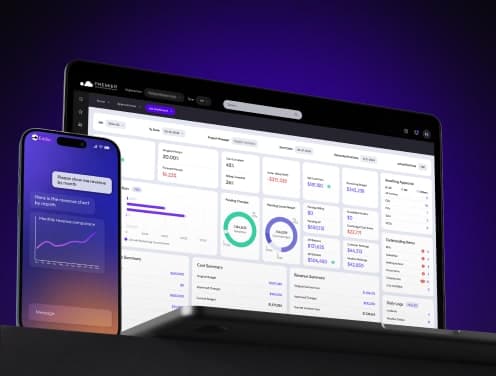
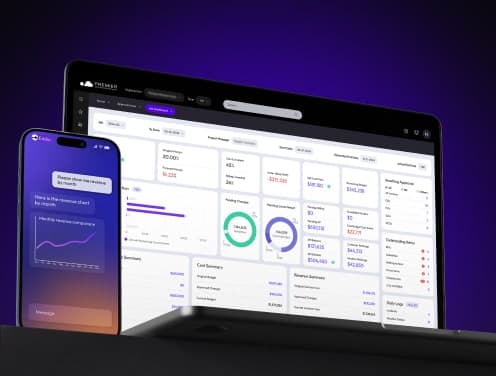
Premier Construction Software is a modern construction ERP. Accounting, project management, job costing, WIP reporting, subcontractor management, field tools, and AI forecasting are all built into one platform. There is no connector, no sync schedule, and no reconciliation between systems (Premier Construction Software).
Real-time job costs, always
Every cost posted in accounting is immediately visible in the job dashboard. Project managers see current actuals, committed costs, and forecasted completion in one view, without waiting on accounting to run a report. "Switching to Premier Construction Software consolidated three systems into one, saving us valuable time. We now have real-time access to financials, actuals, and invoices, keeping us in complete control," said Brock Droescher, PM at Streamline General Contractors (Premier Construction Software).
WIP in 2 clicks
"WIP reports are instantaneously created out of Premier Construction Software. You click a button, that report comes out. In the past it was a big process, took a lot of time," said Mike Van Orman, Nomad Infrastructure (Premier Construction Software). There is no manual assembly, no Excel export, and no reconciliation needed between systems.
AI-powered forecasting
Premier Construction Software's Eddie AI assistant surfaces cost trends, flags red flags, and helps project managers track estimates at completion (EAC) 20% more accurately. "Premier Construction Software allowed us to catch red flags as soon as they happen and protect our margins," said Carlo Frediani, Controller at Broccolini (Premier Construction Software).
Subcontractor portal
Subcontractors submit invoices through Premier Construction Software's portal in 45 seconds. Submissions queue directly into accounts payable. No manual re-entry, no email chains, no missing paperwork. "It takes our subs 45 seconds to submit an invoice now," said Brian Wessels, President of Intent Built (Premier Construction Software).
Implementation that actually works
Premier Construction Software goes live in as few as 60 days, compared to the six to eighteen months typical of legacy ERPs. Implementation is led by construction-specific CPAs and project managers who build a customized Operational Playbook for each customer. "Our source of truth will always be Premier Construction Software," said Nomad Infrastructure (Premier Construction Software). Forbes Advisor named Premier Construction Software the #1 Construction Cloud ERP in 2026 for the fourth consecutive year.
Transparent pricing
Premier Construction Software's pricing is published. Starter tier: $349/user/month (implementation from $15,000). Premium: $249/user/month (implementation from $25,000). Enterprise: $125/user/month (implementation from $50,000). Every tier includes a 30-day money-back guarantee (Premier Construction Software Pricing).
What Contractors Experience After Switching
The results contractors report after consolidating to Premier Construction Software consistently center on time saved, visibility gained, and margins protected.
• "I went from billing for an entire week, 40 hours, to billing in 8 hours on a Saturday. And I'm capturing more costs." (Mark Marshall, Owner, JM Construction)
• "I've gone from probably about 3% profit up to about 8% by using Premier Construction Software because I'm very confident that the numbers are right." (Mark Marshall, JM Construction)
• "In a span of 4 years we've doubled our size with Premier Construction Software. We're doing way bigger projects. We would not have been able to do it without it." (Streamline General Contractors)
• "Premier Construction Software saves us probably upwards of 25% of our daily schedule because of how it's tracking things, entering things, and the approval process has been greatly expedited." (Scott Largley, Ally Construction Services)
• "Since adopting Premier Construction Software over a decade ago, we have grown our revenue by 30x." (Eric Engelke, Engelke Construction Solutions)
Full Comparison: Premier Construction Software vs Procore + Sage vs Procore + QuickBooks
Software | Best For | Starting Price | Key Features | Rating | Verdict |
|---|---|---|---|---|---|
Premier Construction Software | GCs, specialty contractors ($5M–$500M+) needing one system for everything | Transparent tiered pricing; 30-day money-back guarantee | • Real-time job dashboard with cost drilldown • WIP reporting in 2 clicks • AI predictive forecasting (Eddie) • Subcontractor portal; invoice in 45 seconds • Go live in as few as 60 days | 4.7/5 | Best overall for growing contractors. Full construction ERP: accounting, project management, field tools, and AI. One platform, one source of truth. |
Procore + Sage Intacct | Large contractors who can manage two systems and a connector | $10,000–$150,000+/year (Procore); custom quote (Sage) | • Strong project and financial visibility when synced • Pre-existing projects cannot be synced without paid services • Cost codes must originate in Sage; custom WBS not supported | 4.3/5 | Powerful combination, but two separate systems with connector constraints. Sync limitations and integration overhead add cost and complexity. |
Procore + QuickBooks | Smaller contractors already using QuickBooks with basic project needs | $10,000–$80,000+/year (Procore); $30–$200/month (QBO) | • Requires third-party connector (Smoothlink) for QBO • No WIP reporting in QuickBooks Online standard • Job cost reports off by 15–25% without manual correction | 3.8/5 | A common starting point, but real-time sync issues and accounting gaps create friction fast. Most growing contractors outgrow this stack quickly. |
Frequently Asked Questions
Can Procore replace an accounting system entirely?
No. Procore does not have a general ledger, cannot close books, and does not produce WIP schedules or balance sheets. It must be paired with accounting software. Premier Construction Software handles both sides in one platform.
Is the Sage Intacct + Procore integration seamless?
Not completely. Procore's own documentation notes that cost codes must originate in Sage Intacct, custom WBS segments are not supported, and pre-existing projects cannot be synced without paid professional services (Procore Support).
What does the Procore + QuickBooks integration actually require?
Connecting Procore to QuickBooks Online requires a third-party connector such as Smoothlink, which adds ongoing cost and a vendor dependency. QuickBooks Desktop support is more limited. Real-time sync is not guaranteed, and cost code conflicts require manual resolution (Planyard).
Why do construction companies switch from Procore + QuickBooks to Premier Construction Software?
The most common reasons: QuickBooks cannot produce WIP reports, job cost reports are inaccurate without manual correction, and syncing between systems requires ongoing maintenance. Premier Construction Software consolidates both functions into one platform with real-time visibility and no sync dependency.
How long does it take to implement Premier Construction Software?
Premier Construction Software goes live in as few as 60 days. Implementation is led by construction-specific CPAs and project managers. Every customer receives a customized Operational Playbook and a 30-day money-back guarantee.
How does Premier Construction Software price compared to Procore + accounting software?
Premier Construction Software publishes tiered pricing: Starter at $349/user/month, Premium at $249/user/month, Enterprise at $125/user/month. Procore does not publish pricing and uses ACV-based contracts with annual escalation. When you add accounting software, connector licensing, and integration support, the total cost of Procore + an ERP frequently exceeds Premier Construction Software's all-in cost.
The Bottom Line
Procore is a strong project management platform. Sage Intacct and QuickBooks are established accounting tools. But pairing them creates overhead that grows with every project you add. Sync constraints, WIP gaps, duplicate entry, and reconciliation work are structural problems, not configuration issues.
Premier Construction Software eliminates that overhead by handling accounting, project management, job costing, field tools, and forecasting in one system. 800+ customers and 15,000+ users have replaced their disconnected stacks with Premier Construction Software and use it as their single source of truth. For contractors who are ready to stop managing the gap between systems, Premier Construction Software is worth a look (Book a Demo).
Related Reading
• Procore + Sage or QuickBooks: Why It's Not Enough (2026) • CMiC vs Acumatica Cloud ERP 2026 Comparison: Real Cost and Features • Foundation Software vs Procore
Latest articles




Trusted by global leaders
Join those who have put their trust in us