
Construction Industry Trends 2026: What Every Project Manager Needs to Know
Last updated: April 2026
Quick Answer: Construction Industry Trends 2026
The construction industry is navigating rising material costs, chronic labour shortages, and accelerating technology adoption. AI, modular construction, BIM, and modern construction ERP platforms are no longer optional upgrades. They are the baseline for staying competitive and protecting margins in 2026.
Construction drives 13% of global GDP, making it the single largest industry worldwide (Deloitte). And the pace of change has not slowed. The BIM market, valued at $7.92 billion in 2024, is projected to hit $21 billion by 2034 (Grand View Research). AI in construction is expected to surpass $2.3 billion in 2026, expanding at a 30% CAGR (McKinsey). Construction management software alone is on track to grow from $9.3 billion to $23.9 billion by 2031 (MarketsandMarkets).
The impact is measurable. Drones now improve worker safety by 55% (PwC). Modular construction, a $91 billion market, is projected to reach $120.4 billion by 2027 (McKinsey). Meanwhile, the labour market remains tight at roughly 12 million workers nationwide, and demand keeps climbing. Healthcare construction spending is set to grow 5.1%, while education projects are expected to rise 8.2% (Dodge Construction Network).
This article breaks down the technology shifts, economic pressures, and workforce changes shaping construction in 2026, and explains how project managers can act on them.
The 2026 Construction Economy: What's Shaping the Outlook
The economic picture in 2026 is mixed. Some pressures from 2024 have eased. Others have intensified. Understanding these forces is not optional for project managers. They determine how you plan, budget, and execute.
Inflation Trends and Interest Rates
Inflation has cooled since its peak, but construction costs remain 42% above pre-pandemic levels (Associated General Contractors of America). Material prices have stabilized in some categories, yet labour and logistics costs continue to press upward. The Federal Reserve's easing cycle has lowered borrowing costs modestly, but financing remains expensive by historical standards.
For project managers, this environment demands tighter financial discipline:
● Run cost reviews at multiple points throughout a project, not just at the start.
● Build larger contingency buffers to absorb potential price volatility.
● Explore creative financing structures to offset borrowing costs.
Public vs. Private Sector Investment
Public infrastructure investment continues to grow, driven by major federal programmes. The Infrastructure Investment and Jobs Act is still pushing billions into transportation, utilities, and public works across North America (U.S. Department of Transportation).
Private sector construction tells a different story. Commercial real estate remains sluggish in many urban markets, as office vacancy rates stay elevated. However, industrial construction is holding strong. Data centres, logistics facilities, and manufacturing plants are seeing robust demand as companies rebuild supply chain resilience.
Multi-family residential continues to perform well. Housing shortages in major metropolitan areas are not going away, which is keeping demand for purpose-built rental and affordable housing elevated.
Regional Growth Disparities
The Atlantic provinces of Canada saw a 170% jump in construction starts heading into 2026, creating intense competition for labour and materials in markets that were previously slower (Statistics Canada). Alberta, by contrast, has seen construction starts drop nearly 50% over the same period.
The U.S. mirrors this pattern. The Southeast and Southwest continue to lead construction activity, while parts of the Midwest and Northeast see more modest growth.
Effective project managers treat regional variation as a strategy input, not background noise. That means:
● Adjusting labour rates to reflect local market conditions.
● Sourcing materials regionally when possible to reduce logistics exposure.
● Building strong relationships with regional subcontractors who understand local permit timelines, code requirements, and supply networks.
Labour Shortages and Workforce Shifts
The construction industry needs an estimated 439,000 additional workers in 2026 alone to meet demand (Associated Builders and Contractors). Roughly 20% of the current workforce is expected to retire within the next decade, and the pipeline of new entrants is not keeping pace.
Wages have responded. First-year wage increases in construction averaged 4.6% by mid-2025, with 91% of firms reporting they raised base pay for hourly positions (AGC Workforce Survey). Despite that, 94% of construction firms still report difficulty filling positions.
Immigration remains central to the equation. Immigrants account for one in four construction workers overall. In specific trades like plastering, drywall installation, and roofing, that share reaches 50-61%.
Forward-thinking companies are addressing this by investing in their existing workforce. About 42% of firms increased spending on training and professional development over the past year (ABC). Learning management systems have moved from a nice-to-have to an operational tool for firms that want to grow without depending entirely on external hiring.
Material Costs and Supply Chain Pressures
Material costs remain a persistent problem in 2026, with prices still 42% above pre-pandemic levels (AGC). Stability has returned to some categories, but new volatility sources have emerged.
What Is Driving Price Volatility in 2026
Electrical components continue to face the most severe pressure. Generators, switchgear, and condenser units have extended lead times due to explosive growth in data centre construction. Copper demand has surged alongside it.
HVAC is under similar strain. Orders are at historic highs, but domestic production has not kept pace. Nearly 36% of HVAC demand is now filled by imports, creating procurement delays that affect project schedules.
Labour shortages throughout the supply chain compound material availability problems. Even when materials exist, getting them moved, installed, and inspected on time requires workforce coordination that the current tight labour market makes difficult.
Tariffs, Trade Policy, and Global Sourcing
Trade policy has reshaped construction material costs significantly. The effective tariff rate on U.S. construction imports has surged to 27.7%, up from 0.9% prior to recent policy changes (U.S. Census Bureau). Roughly one-third of construction-related goods are imported.
Steel and aluminum tariffs have reached 50%. A similar 50% duty on copper took effect in 2025 (U.S. Trade Representative). Lumber tariffs on Canadian imports, which supply 85% of U.S. demand, currently sit at 14.5%, with signals that this rate could more than double.
Domestic producers have responded with their own price increases. Steel mill products rose 5.1% over the past year. Aluminum mill shapes climbed 6.3%.
How Project Managers Can Plan Around Uncertainty
Given this environment, the most effective project managers are shifting from reactive to proactive procurement:
1. Include price escalation provisions in contracts. Material price escalation amendments can document the impact of tariffs for change order and claims purposes.
2. Define delivery and supply terms precisely. Ambiguous sourcing language creates disputes when markets shift.
3. Consider strategic stockpiling for critical components where storage logistics allow.
4. Diversify supplier relationships across regions to reduce dependency on any single source exposed to trade policy changes.
Technology Trends Every Project Manager Should Track
Building Information Modeling (BIM) Adoption Rates
BIM has crossed from early adoption into standard practice. Recent data shows 74% of architecture firms now use BIM, with large firms at 100% (NBS National BIM Report). About 73% of practices report knowing and using BIM, up from 62% in 2017.
The results are measurable. Companies using BIM see 25% reductions in labour needs, 25% better efficiency, 5% lower overall costs, and projects finish 5% faster (McKinsey Global Institute). Projects are 30% less likely to face delays, and risk-related costs drop by up to 25%.
BIM has expanded well beyond 3D modelling. 8D models now integrate scheduling, cost tracking, and facility management. The technology is converging with IoT and cloud infrastructure into what the industry increasingly calls Digital Information Management.
Construction Management Software: What to Look For
Construction professionals lose roughly 35% of their time, over 14 hours per week, searching for information and resolving conflicts caused by disconnected systems (FMI Corporation). Poor project management and miscommunication drive 48% of all rework. Direct rework costs consume 4-6% of total project budgets. Add indirect costs, and that number reaches 9%.
Modern construction management platforms address this by connecting field and office in real time. The features that matter most:
● Real-time collaboration tools that keep field and office aligned.
● Cloud-based document management accessible from any device.
● AI-powered analytics for resource planning and risk identification.
● IoT integration for site monitoring and equipment tracking.
● Automated approval workflows to accelerate decision-making.
Premier Construction Software: A Modern Construction ERP
"Premier does everything great. It does everything you want it to do. It does it in a very easy to understand way. And it correlates all of your data and puts it in one location that your entire team can access and use very effectively. -- Scott Largley, Senior PM, Ally Construction Services"
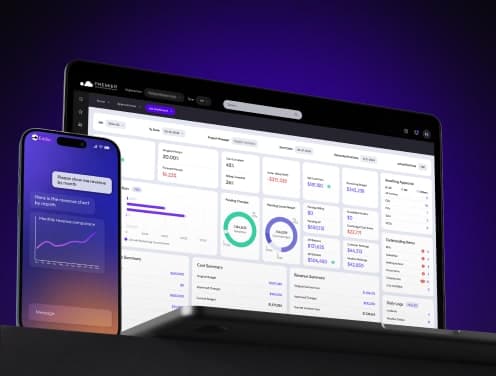
Premier is a modern construction ERP built specifically for general contractors, developers, and home builders. It replaces disconnected systems with a single platform covering accounting, project management, field tools, a subcontractor portal, document management, and AI-powered forecasting (premiercs.com).
Over 800 customers and 15,000 users across North America rely on Premier. The platform delivers:
● Job cost visibility: Real-time job cost dashboard
● WIP reporting: WIP report generated in 2 clicks, no manual assembly.
● Subcontractor portal: Subcontractors can submit invoices in 45 seconds via the portal.
● Fast implementation: Implementation in as few as 60 days, led by construction-specific CPAs and project managers.
● AI-powered: Eddie AI assistant for on-demand financial insights and predictive red flag identification.
● Multi-entity: Multi-entity financial management from a single dashboard.
● Mobile access: Mobile field app for time entry, expenses, and receipts that import directly into the system.
● OData: OData-powered real-time modeling and analysis.
● Innovation cadence: 540 product enhancements per year, 26 software releases.
"I went from billing for an entire week, 40 hours, to billing in 8 hours on a Saturday. And I'm capturing more costs. I've gone from probably about 3% profit up to about 8% by using Premier because I'm very confident that the numbers are right." -- Mark Marshall, Owner, JM Construction
Premier earned Forbes #1 Construction Cloud ERP in 2026 and holds a 4.6/5 rating across more than 1,000 reviews on G2, Capterra, GetApp, and Software Advice (Forbes Advisor). The platform is backed by Constellation Software ($68B USD publicly traded), providing long-term financial stability and a commitment to continuous product development.
AI and Predictive Analytics in Project Planning
AI and predictive analytics are changing how construction projects get planned and managed. They do not replace judgement. They make it faster and more reliable.
AI for Resource Allocation and Scheduling
AI-powered scheduling tools analyse live data to distribute labour, equipment, and materials more effectively across projects. Companies using AI for workforce management have seen 12% improvements in labour productivity (McKinsey). Projects that use AI for resource allocation have cut spending by 10% through better utilisation. AI planning tools have reduced delays by up to 20%.
The value is practical. These systems surface issues before they escalate, rather than after they have already cost time and money. Project managers get more time for decisions that actually require human judgement.
Predictive Analytics for Risk Mitigation
Predictive models analyse historical project data, market conditions, and external factors to quantify risk before it materialises. Companies using AI safety tools have seen workplace accidents drop by up to 25% (PwC).
The shift is from reactive to proactive. Systems identify patterns that precede common problems: cost overruns, schedule delays, and safety incidents. Project managers can intervene before these patterns become problems.
"Premier allowed us to catch red flags as soon as they happen and protect our margins." -- Carlo Frediani, Controller, Broccolini
Modular and Prefabricated Construction
Modular construction is gaining ground quickly. Market research shows 27% of all planned new buildings in 2026 will incorporate prefabrication, with that number expected to reach 35% by 2030 (Dodge Construction Network).
Benefits of Off-Site Construction
The controlled factory environment improves quality by removing weather variability and labour inconsistencies from the equation. The environmental benefits are material:
● Modular construction generates 50% less waste than traditional site builds.
● Modular buildings use 67% less energy during construction.
● Prefabricated methods deliver projects 30-50% faster through parallel processing.
● Off-site construction saves 20% of total costs on low-rise multi-family projects.
● Vehicle traffic at construction sites drops by 56%.
Industries Leading Modular Adoption
Education is the leading adopter. Schools and universities choose prefabricated solutions to accommodate enrolment changes with minimal disruption. Healthcare facilities follow, with hospitals and emergency care units requiring high-quality structures built quickly. Hotels, government buildings, commercial spaces, and apartment complexes round out the major users.
The U.S. lags behind northern Europe on modular adoption. Modular construction accounts for just 3% of U.S. residential construction, compared to 45% in Finland, Norway, and Sweden (McKinsey Global Institute). The gap represents a real opportunity for contractors willing to invest in prefab capabilities.
Smart Cities and IoT Integration
Smart city investment represents a global market of $410.8 billion, expected to reach $820.7 billion within the next several years (IDC). For construction professionals, this means a growing segment of projects will require IoT integration as a base expectation, not a premium add-on.
IoT-Enabled Infrastructure and Buildings
IoT applications in construction have expanded substantially in the Construction 4.0 era. Sensors monitor temperature, air quality, noise, and dust levels, transmitting real-time data and triggering alerts when conditions reach unsafe thresholds. IoT-enabled tags track the location and usage of materials and equipment across sites.
Smart buildings apply data from sensors, user devices, and building systems through AI and machine learning, making them programmable and responsive to occupants and facilities teams alike.
One of the most significant advances is the connection between BIM and IoT. When sensors detect a problem, site activities link directly to 3D models, highlighting the exact location of the issue. This turns reactive troubleshooting into real-time site intelligence.
Smart City Construction Examples
Singapore's government is working with AVEVA to transform Punggol into a visualization-ready digital twin, combining IoT and AI to test products and concepts in a live urban environment. Copenhagen is using technology to reduce traffic congestion, air pollution, and CO2 emissions as part of its goal to become the world's first carbon-neutral city. Barcelona deployed its "Sentilo" system across 150,000 lamp posts, 40,000 garbage containers, and 80,000 parking spots, creating open data on energy use and urban conditions.
Sustainable Construction and Green Building
Sustainability has moved from a marketing talking point to a procurement requirement. Market demand, regulation, and investor pressure are all pushing in the same direction.
Energy-Efficient Design and Materials
Energy-efficient design starts with the building envelope. The foundation, roof, walls, doors, and windows collectively determine interior climate conditions and account for the majority of a building's energy load. Modern builds are reintroducing passive temperature control techniques that were largely abandoned when electrical energy became widely available.
Optimising heating and cooling design remains the fastest path to reducing energy costs. Buildings designed to energy-saving standards require more upfront investment but deliver lower operating costs throughout their lifespan.
LEED Certifications and ESG Compliance
LEED (Leadership in Energy and Environmental Design) remains the most recognised green building certification worldwide. The four certification levels are:
● Certified: 40-49 points
● Silver: 50-59 points
● Gold: 60-79 points
● Platinum: 80+ points
ESG compliance has outgrown basic regulatory obligation. The environmental pillar targets lower emissions, reduced waste, and low-impact materials. Construction companies that can demonstrate strong ESG performance are increasingly winning bids from institutional clients and public agencies.
Carbon-Negative and Recycled Materials
Carbon-negative materials capture more carbon than they release during production. Scientists at Northwestern University created a carbon-negative building material using seawater, electricity, and CO2, locking carbon dioxide permanently while producing materials usable in concrete, cement, plaster, and paint.
Recycled materials are both a cost strategy and an environmental one. Fly ash and slag cement, for example, often outperform virgin materials while reducing the emissions associated with extraction and processing.
Advanced Materials: Biocement to Self-Healing Concrete
Living Building Materials
Living building materials (LBMs) function like organisms. They can repair themselves and, in some cases, self-replicate. Biocement develops through microbiologically induced calcite precipitation. When cracks form and water penetrates, dormant bacteria activate, consuming calcium lactate and producing limestone that fills the damage automatically.
Self-replicating concrete takes the concept further, using bacteria that absorb carbon dioxide rather than releasing it, directly inverting the carbon footprint of standard concrete production.
Smart Materials and Embedded Sensors
Fibre-optic sensors woven into composites monitor material conditions in real time. Shape memory alloys create internal forces and adjust stress levels in controlled ways when incorporated into structural composites. High-definition fibre optic sensing provides sub-millimetre accuracy along the sensor's entire length.
Mass Timber and Carbon-Capturing Concrete
Mass timber, including cross-laminated, nail-laminated, and glue-laminated timber, costs roughly the same as traditional materials but carries a significantly smaller carbon footprint. Using mass timber instead of concrete and steel cuts emissions by 13% to 26.5%.
Carbon-capturing concrete technologies like CarbonCure inject CO2 into fresh concrete, where it mineralises and becomes permanently trapped, while simultaneously increasing the concrete's compressive strength.
Robotics and Automation on the Jobsite
Robots and autonomous machines are solving two construction problems at once: worker shortages and site safety. They are not replacing skilled tradespeople. They are handling the tasks most likely to cause injury or burnout.
Construction Robots: TyBOT, SAM, and Others
TyBOT ties more than 1,200 rebar intersections per hour with 99% accuracy, working among crews without pre-mapping or programming. At the Freedom Road bridge in Pennsylvania, TyBOT tied 24,000 intersections at 5.5 seconds each.
SAM (Semi-Automated Mason) places 380 bricks per hour, six times faster than a human mason, while reducing the physical strain of repetitive bricklaying. Specialised robots like Robo-Carrier move heavy materials and Robo-Welder handles steel column welding using laser shape measurement. These machines reduce manpower requirements for specific tasks by 70-80%.
Autonomous Vehicles and Drones
The construction drone market is projected to reach nearly $12 billion by 2027 (Drone Industry Insights). Drones map and measure sites quickly, covering 120 acres per hour with one operator, making the work 60 times more efficient than manual survey methods.
Missing project data, rework, and conflict resolution cost construction companies $177 billion annually (FMI Corporation). Drones address this directly through real-time site monitoring and high-resolution quality inspection. Self-driving construction equipment now operates legally in 22 U.S. states, with Komatsu, Caterpillar, and John Deere leading adoption.
Field Layout Automation with Dusty Robotics
Dusty Robotics' FieldPrinter 2 prints digital blueprints directly onto construction surfaces. The robot works 10 times faster than manual methods, covering 10,000-15,000 square feet daily with a single operator, at 1/16" accuracy. It prints as close as 1.75 inches from obstacles.
"With Dusty we're able to have everybody work together and we can see if there are issues with layout points in the CAD before we lay them out in the field." -- Andrea Hernando, Senior Construction Tech Innovation Engineer
Key Takeaways
The construction industry in 2026 rewards project managers who adapt ahead of the market, not after it. The essential actions:
● Labour shortages are structural, not cyclical. With 439,000 additional workers needed this year and 20% of the workforce retiring within a decade, invest in upskilling and consider prefab to reduce on-site labour dependency.
● Material costs demand proactive planning. Prices remain 42% above pre-pandemic levels, with tariffs reaching 27.7% on imports. Build price escalation clauses into contracts and diversify suppliers.
● Technology adoption has moved from advantage to baseline. AI-powered analytics, BIM, and digital twins are the standard for competitive operations. Teams still relying on spreadsheets and disconnected systems are losing ground.
● Sustainability drives long-term profitability. Green buildings are 25% more energy-efficient and reduce operational costs by up to 37%. ESG compliance is increasingly a requirement for winning institutional bids.
● Regional strategies beat generic ones. Construction starts vary dramatically by region. Workforce pricing, procurement, and subcontractor relationships all need to reflect local market conditions.
Frequently Asked Questions
What are the biggest challenges facing construction project managers in 2026?
The top challenges are labour shortages, material cost volatility, and the pressure to adopt new technology quickly. Regionally, some markets face intense competition for workers and materials while others are contracting. Managing all three simultaneously requires tighter financial systems and real-time data access.
How is AI changing construction project management?
AI improves scheduling, resource allocation, and risk identification. It surfaces issues before they become problems rather than after they have already cost time and money. Predictive analytics has reduced project delays by up to 20% and cut workplace accidents by up to 25% in early-adopter firms.
What strategies help address construction labour shortages?
The most effective approaches combine workforce investment with technology. Companies are increasing training budgets, expanding apprenticeship programmes, and using prefabrication to reduce on-site labour requirements. Learning management systems are becoming central tools for firms that want to grow without depending entirely on a tight external labour market.
Can sustainable construction practices stay within budget?
Yes. Low-carbon materials, smart building technologies, and life cycle cost analysis often deliver long-term savings that offset higher upfront investment. Green buildings typically reduce operating costs by up to 37% over their lifespan.
What economic factors are shaping construction in 2026?
Key factors include persistent material cost inflation, high import tariff rates (27.7% effective rate on construction goods), Federal Reserve rate policy, the balance between public infrastructure spending and softer private commercial markets, and significant regional disparities in construction activity.
Construction ERP and Project Management Software Comparison
The table below compares leading construction software platforms across the dimensions that matter most for project managers evaluating their options in 2026. Premier's row is highlighted.
Software | Best For | Starting Price | Key Features | Rating | Verdict |
|---|---|---|---|---|---|
Premier Construction Software | General contractors and developers ($5M–$500M+) who need a true all-in-one construction ERP | Contact for pricing | 1. Real-time job cost dashboard with 2-click WIP report 2. AI-powered forecasting and red flag identification (Eddie AI) 3. Automated change order, billing, and approval workflows 4. Subcontractor portal (45-second invoice submission) 5. Multi-entity financial management 6. Mobile field app for time entry, expenses, and receipts 7. Document management: submittals, RFIs, drawing management 8. OData-powered real-time modeling and analysis 9. Smart UI for accounts payable 10. Implementation in as few as 60 days | 4.6/5 (1,000+ reviews) Forbes #1 Construction Cloud ERP 2026 | Best overall construction ERP for growing mid-market contractors. Fastest implementation, strongest support, all-in-one platform. |
CMiC | Large enterprise contractors with complex multi-entity needs | Contact for pricing | 1. Full ERP with financials and project controls 2. HR and payroll modules 3. Deep compliance and audit tools 4. Heavy customization options | 3.9/5 | Enterprise-grade but long implementation timelines (6-18 months) and steep learning curve. |
Sage 300 CRE | Established contractors looking to replace an older legacy system | Contact for pricing | 1. Job costing and project management 2. Accounts payable and receivable 3. Payroll processing 4. Equipment management | 3.7/5 | Legacy architecture and clunky UI make adoption difficult. Limited innovation cadence. |
Acumatica | Contractors who need a general cloud ERP with construction modules added on | From ~$1,800/month | 1. Cloud-based ERP with construction edition 2. Project accounting and cost tracking 3. CRM and field service modules 4. Partner-driven implementation | 4.3/5 | Flexible general ERP but not construction-native. Requires customization to match construction workflows. |
Procore | Teams that need project management only, with no accounting requirement | From ~$375/month | 1. Project management and scheduling 2. Document control and RFIs 3. Subcontractor management 4. No accounting or ERP capabilities | 4.5/5 | Strong PM tool but not an ERP. Most customers pair it with another accounting system, creating the data fragmentation Premier solves. |
Ratings sourced from G2, Capterra, Software Advice, and GetApp as of Q1 2026. Pricing reflects publicly available information and is subject to change.
Ready to Modernize Your Construction Operations?
Premier is a modern construction ERP trusted by 800+ contractors and developers across North America. Go live in as few as 60 days. See the job dashboard in a live demo: premiercs.com/book-a-demo.
"Premier solved all of our business problems. It was an obvious choice." -- Streamline General Contractors
Latest articles



Trusted by global leaders
Join those who have put their trust in us